Guide
Surgical instrument names and uses
This guide covers the instruments in a general surgery or suturing set, grouped by what they do. For each one you get what it is for, how to recognise it, and how to tell it apart from patterns that look alike.
Written by the INSTROFINE team. Updated 28 November 2026. How we checked it is explained at the end. The images show the INSTROFINE instruments named; each was made from a reference photo of that instrument and checked against it. This guide helps you identify instruments; it does not teach surgical technique.
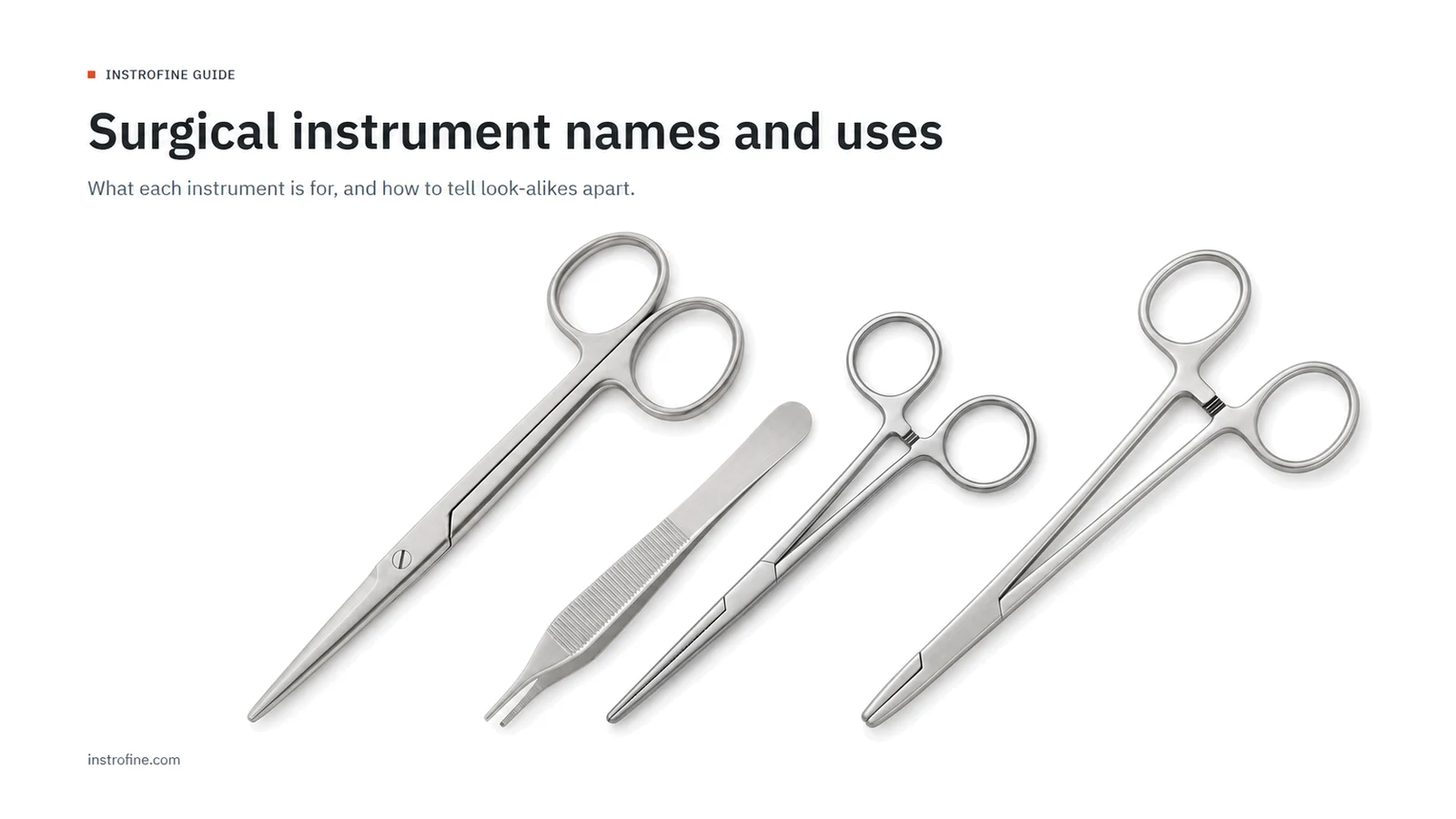
The six groups at a glance
| Group | What they do | Examples |
|---|---|---|
| Scissors | Cut tissue, sutures and dressings | Mayo, Metzenbaum, iris, stitch scissors |
| Thumb forceps (pickups) | Hold tissue or dressings between thumb and fingers; no lock | Adson, DeBakey, tissue, dressing forceps |
| Artery forceps (hemostats) | Clamp vessels or tissue and stay closed with a ratchet | Mosquito, Crile, Kelly, Kocher |
| Needle holders (needle drivers) | Hold a curved suture needle while you stitch | Mayo-Hegar, Olsen-Hegar, Webster |
| Retractors | Hold a wound or tissue open so the field can be seen | Army-Navy, Senn, Deaver, Weitlaner |
| Suction | Remove blood and fluid from the field | Yankauer |
How to read an instrument's name
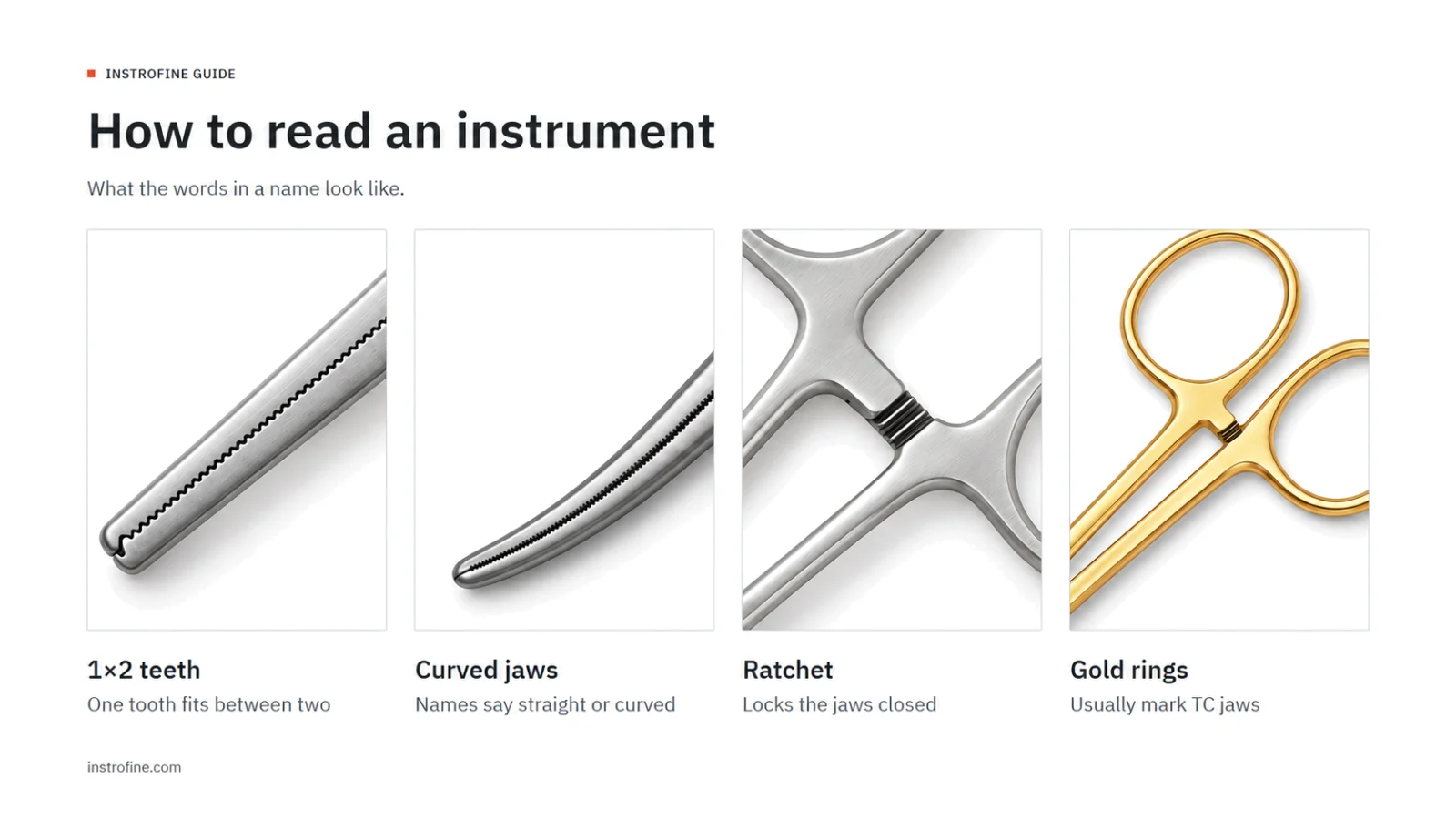
- Pattern name. Usually a surgeon’s name, such as Kelly, Crile or Metzenbaum. Many makers produce the same pattern.
- Length. Given in cm, sometimes in inches (1 in = 2.54 cm). A longer instrument reaches deeper.
- Straight or curved. Describes the jaws or blades.
- Teeth. Written per jaw: “1×2” means one tooth on one jaw that fits between two teeth on the other. Jaws without teeth are serrated or smooth.
- Ratchet. The lock between the finger rings. Artery forceps and most needle holders have one; thumb forceps do not.
- TC. Tungsten carbide inserts in the jaws or blades, harder than the stainless steel body. Makers usually mark them with gold finger rings, but read the listing rather than going by colour.
Scissors
Scissors differ in blade weight, tip shape and length. One rule to keep: fine dissecting scissors, such as Metzenbaum and iris scissors, are never used on sutures. All surgical scissors
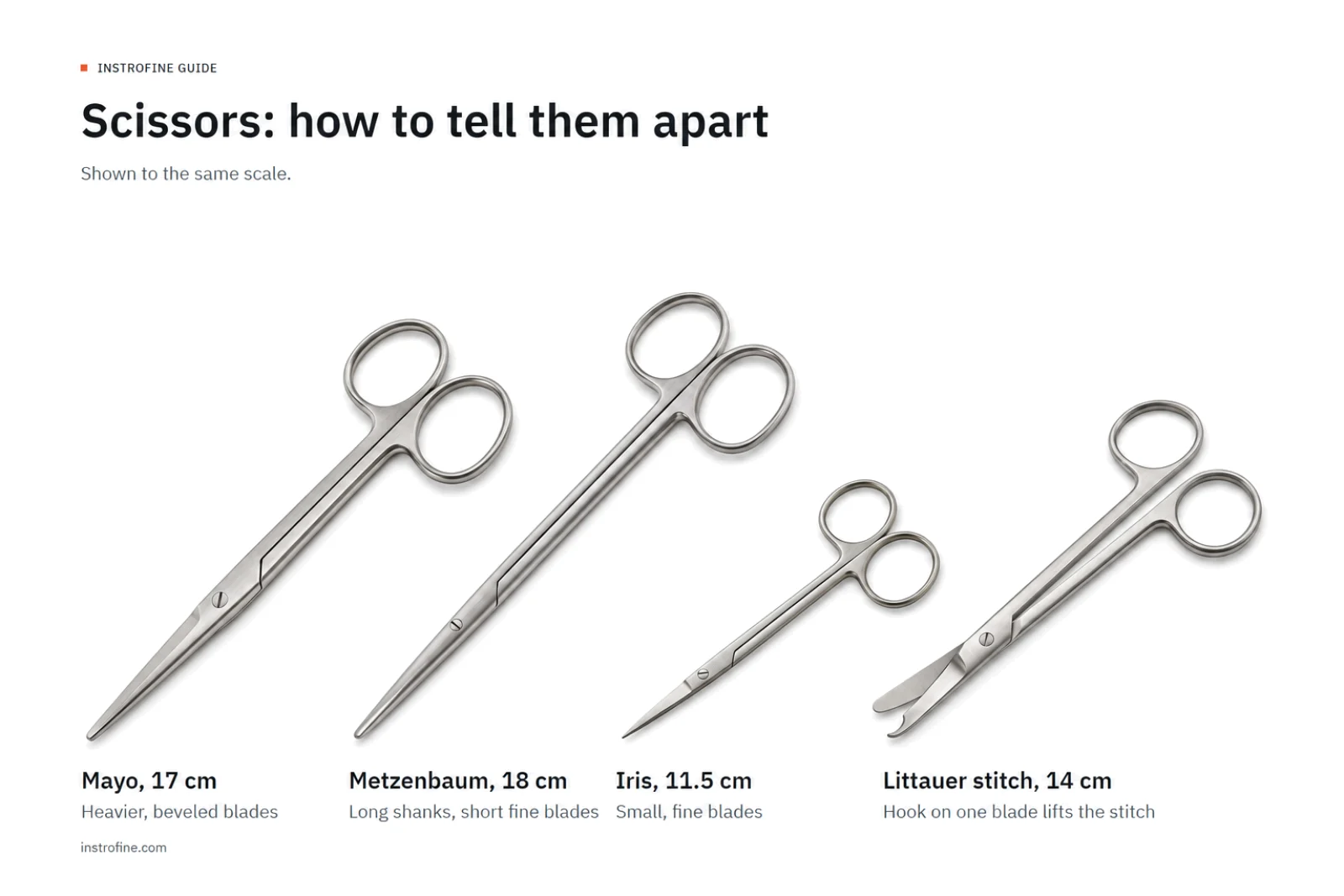
| Mayo | Metzenbaum | Iris | Stitch | |
|---|---|---|---|---|
| Blades | Heavier, beveled | Long shanks, short fine blades, rounded tips | Small, fine | Small hook on one blade |
| Used for | Tougher tissue such as fascia; straight Mayo also cuts sutures | Delicate tissue, fine dissection | Fine cuts in small fields | Removing sutures |
| Our lengths | 15–23 cm | 12.5–26 cm | 9.5–11.5 cm | 11.5–14 cm |
- Mayo scissors. Beveled blades for tougher tissue such as fascia; the straight pattern is also used for sutures. 15, 17 or 23 cm, straight or curved. Choose this for general heavier cutting. Mayo Dissecting Scissors · original pattern, rounded blades · Baby Mayo, 15 cm
- Metzenbaum scissors. Long shanks, short blades and rounded tips for fine dissection. Not for sutures. 15 to 26 cm, straight or curved. Metzenbaum Dissecting Scissors · Baby Metzenbaum, 12.5 cm · delicate, curved. Not sure whether you need a Metzenbaum or a Mayo? See Metzenbaum vs Mayo scissors.
- Iris (eye) scissors. Small scissors with large finger rings for fine, precise cuts; first made for eye surgery. Straight or curved, sharp or blunt tips, 9.5 to 11.5 cm. Eye Scissors · ribbon-style rings
- Tenotomy scissors. Very thin blades with tapered tips for precise cutting in small, deep spaces. Stevens Tenotomy Scissors, 12.5 cm
- Stitch scissors. The hook on one blade slides under a stitch and lifts it before you cut. Littauer, 11.5 or 14 cm · Spencer, straight, both in packs of 2.
- Operating scissors. Long, strong scissors for dense tissue in deep fields, and general-purpose pairs for sutures, gauze and dressings. Mayo-Harrington, 20–30 cm · Cooper · Deaver
- Sims scissors. Long, curved, beveled blades for pelvic and vaginal surgery. Sims Scissors, curved
Thumb forceps (pickups, surgical tweezers)
Spring handles, no lock: you hold them like a pen. The tip decides the use. Teeth hold skin and tough tissue firmly. Serrated jaws without teeth suit dressings and gauze. Atraumatic jaws hold vessels and delicate tissue without piercing them. All thumb forceps
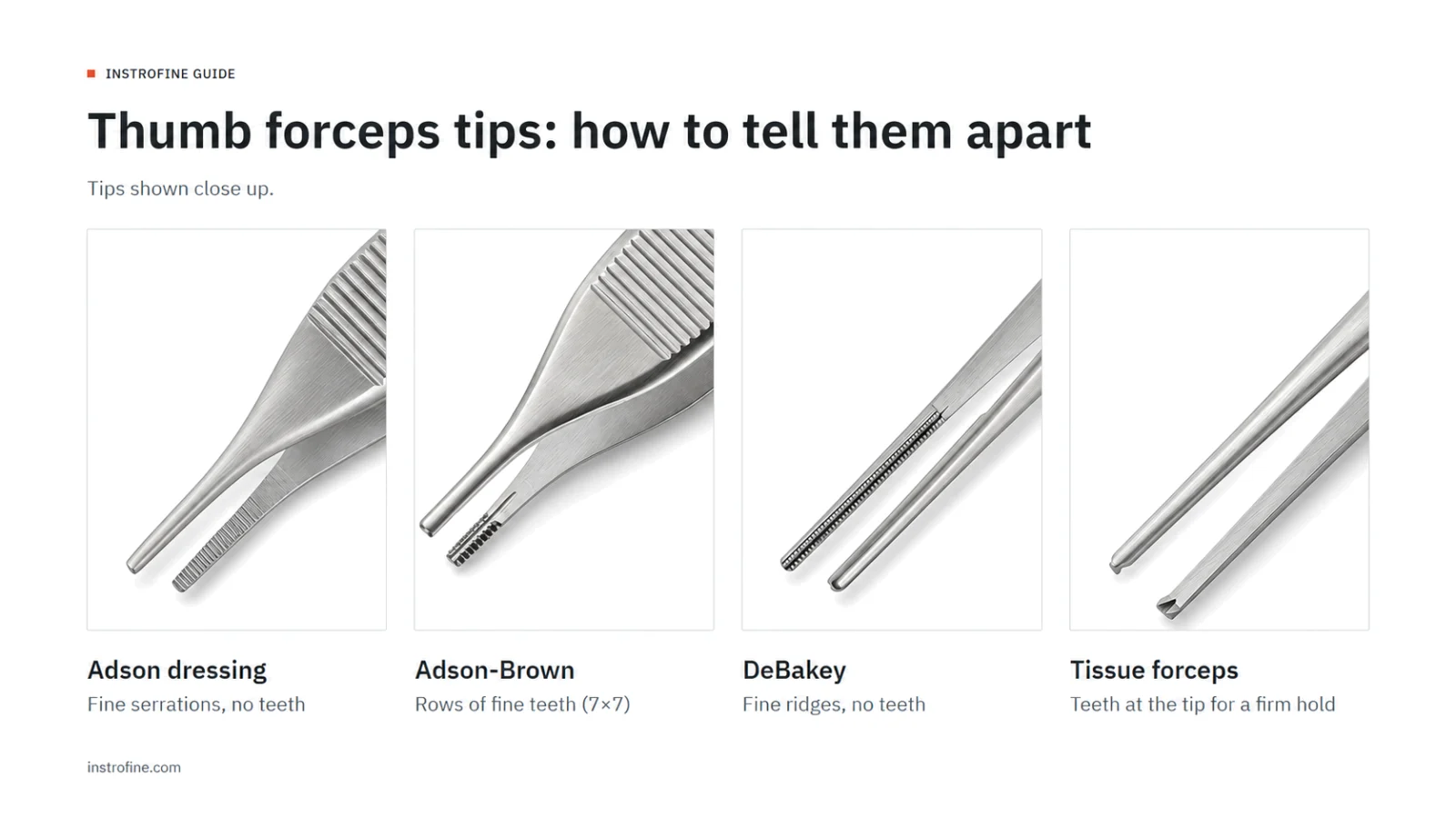
| Adson dressing | Adson-Brown | DeBakey | Standard tissue | |
|---|---|---|---|---|
| Tip | Fine, serrated | Rows of fine teeth (7×7) | Atraumatic ridges, no teeth | Toothed |
| Used for | Gauze, dressings, soft tissue | Skin edges, delicate tissue with less pressure | Vessels, delicate tissue | Firm hold on tissue |
| Our lengths | 12, 15 cm | 12 cm | see listing | 11.5–40 cm |
- Adson dressing forceps. Broad serrated grip with a fine serrated tip. 12 or 15 cm, pack of 2. Adson Dressing Forceps
- Adson-Brown forceps. Many fine 7×7 teeth that hold skin edges with less pressure. 12 cm. Adson-Brown Tissue Forceps
- DeBakey forceps. Fine interlocking ridges instead of teeth, for vessels and delicate tissue. DeBakey Tissue Forceps
- Tissue forceps, standard pattern. Toothed tip and serrated handle; eight lengths from 11.5 to 40 cm. Tissue Forceps
- Dressing forceps. Serrated jaws with blunt, rounded tips for dressing changes. Pack of 2. Dressing Forceps, blunt tips
- Russian forceps. Wide, rounded head with teeth around the rim for dense tissue. Russian Tissue Forceps
- Ferris-Smith forceps. Strong forceps with 1×2 or 2×3 teeth and a wide, ridged grip. Ferris-Smith Tissue Forceps
- Fine patterns for eye and microsurgery:
Artery forceps (hemostats)
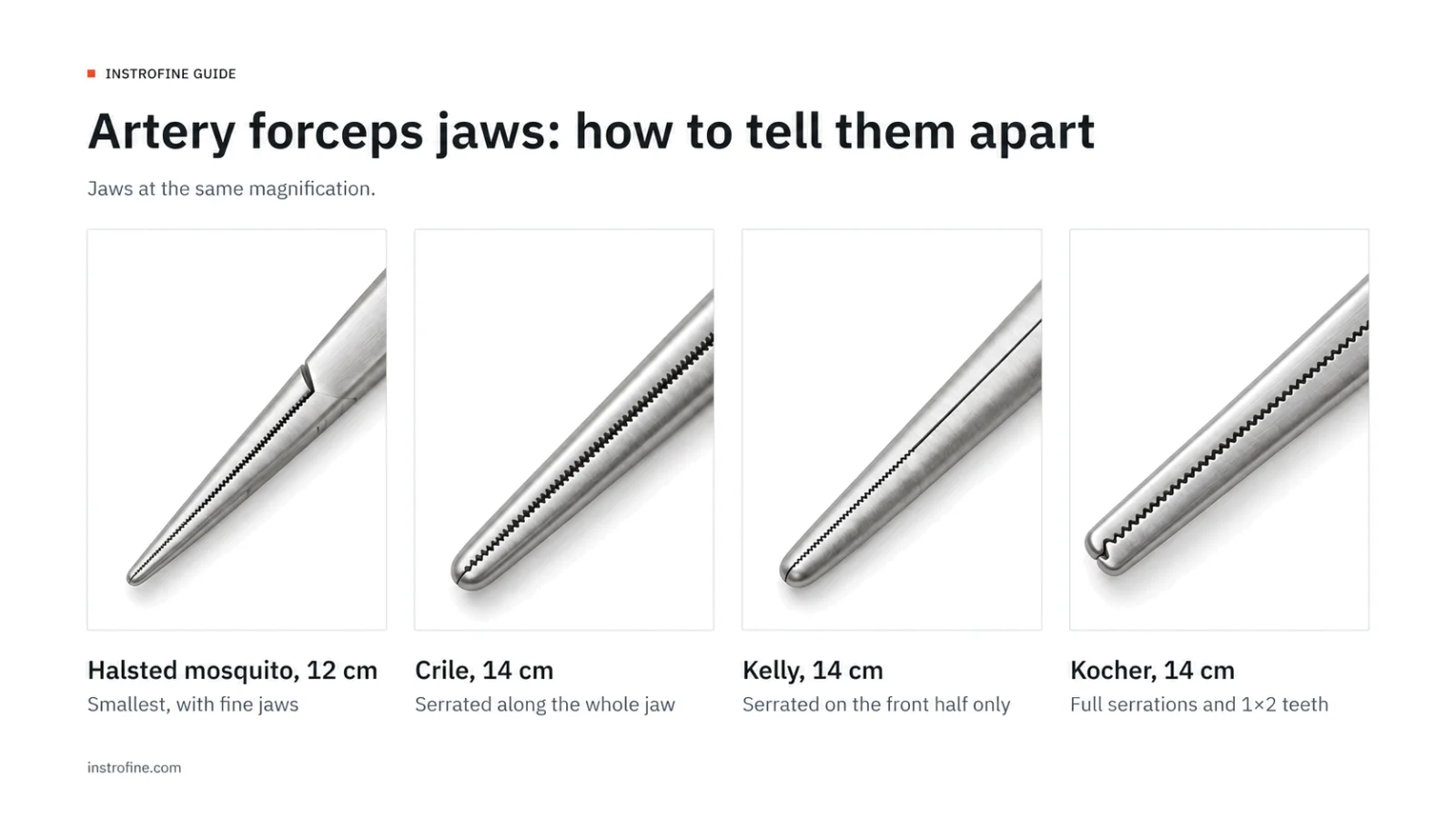
Artery forceps, also called hemostats or haemostats, have ring handles and a ratchet that keeps the jaws closed. The patterns differ in three ways: how much of the jaw is serrated, whether the tip has teeth, and length. All artery forceps
| Pattern | Serrations | Teeth | Our lengths |
|---|---|---|---|
| Halsted mosquito | Fine, full jaw | None, or 1×2 | 12, 18 cm |
| Crile | Full jaw | None, or 1×2 | 14–18 cm |
| Kelly | Front half of the jaw only | None | 14 cm |
| Kocher (Rochester-Ochsner) | Full jaw | 1×2 | 14–35 cm |
| Rochester-Péan | Full jaw | None | 16–30 cm |
| Rochester-Carmalt | Lengthwise, with a cross-serrated tip | None | straight or curved |
| Adson | Slim, delicate jaws | None | 15, 19 cm |
| Mixter | Fine; tips curve upwards | None | slightly or fully curved |
- Kelly or Crile? Look at the jaw. Kelly is serrated on the front half only; Crile is serrated all the way.
- Mosquito is the smallest, with the most delicate jaws.
- Kocher’s 1×2 teeth stop firm tissue from slipping.
- Rochester-Carmalt is used to clamp large vessels and tissue pedicles.
- Mixter’s upturned tips work around vessels and ducts.
Needle holders (needle drivers)
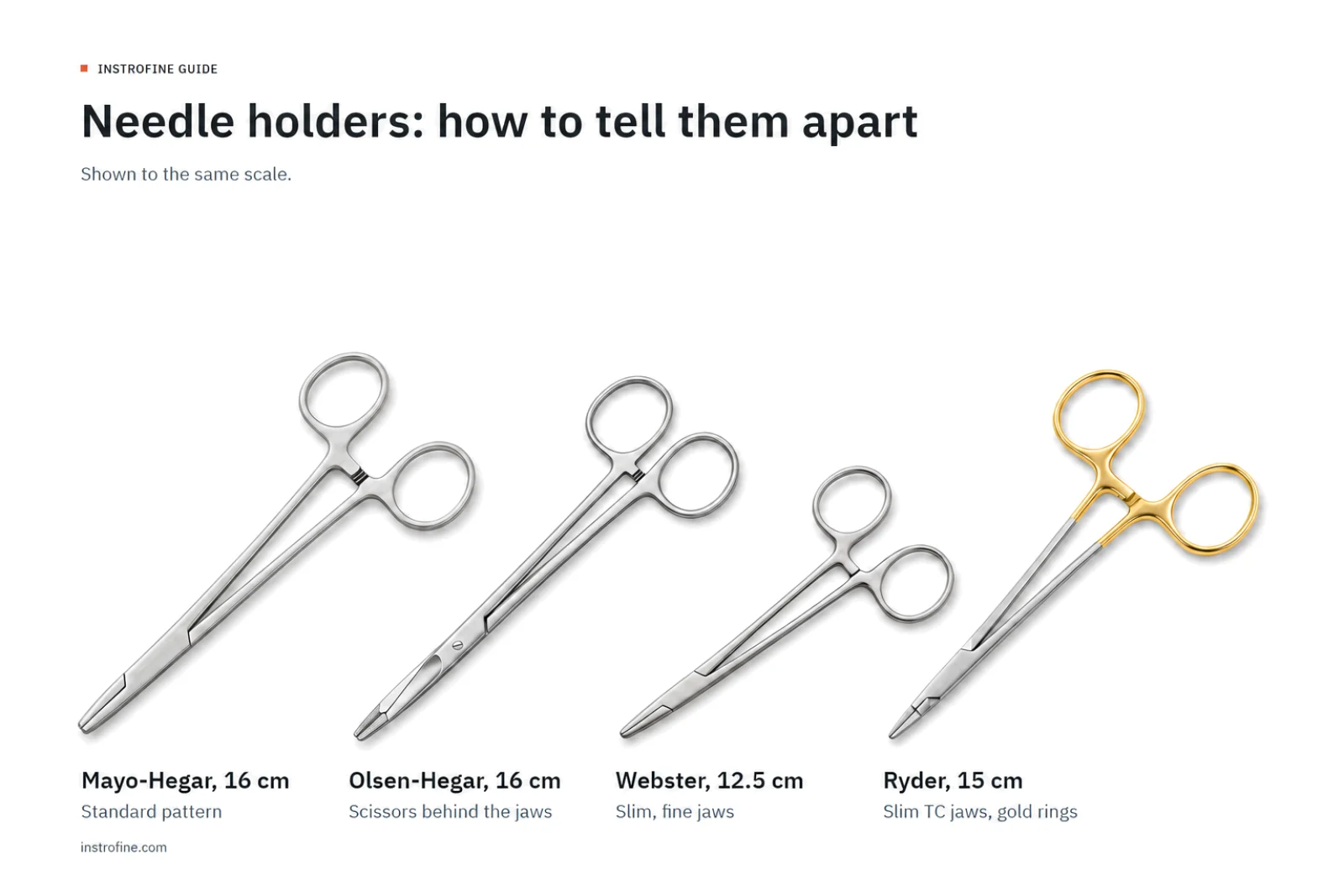
A needle holder grips a curved suture needle. Most lock with a ratchet. Match the jaws to the needle: fine jaws for small needles and fine sutures, the standard pattern for general use. All needle holders
| Mayo-Hegar | Olsen-Hegar | Webster / Ryder / mosquito | Mathieu | |
|---|---|---|---|---|
| Difference | Standard pattern, cross-serrated jaws | Scissors behind the jaws | Slim, fine jaws | Held in the palm |
| Our lengths | 14–20 cm | 12–18 cm | 12.5–18 cm | see listing |
- Mayo-Hegar. The standard pattern. 14, 16, 18 or 20 cm. Mayo-Hegar Needle Holder
- Olsen-Hegar. Holds the needle and cuts the suture with one instrument. Serrated or TC jaws. Olsen-Hegar Needle Holder
- Webster, Ryder, mosquito. Slim jaws for small needles and fine sutures.
- Mathieu. Pliers-style handles with a leaf spring and a ratchet at the end. Mathieu Needle Holder
Retractors
Hand-held retractors are held by an assistant. Self-retaining retractors hold the wound open on their own with a ratchet or frame. Sharp prongs hold firmly; blunt prongs are gentler on vessels and nerves. All retractors
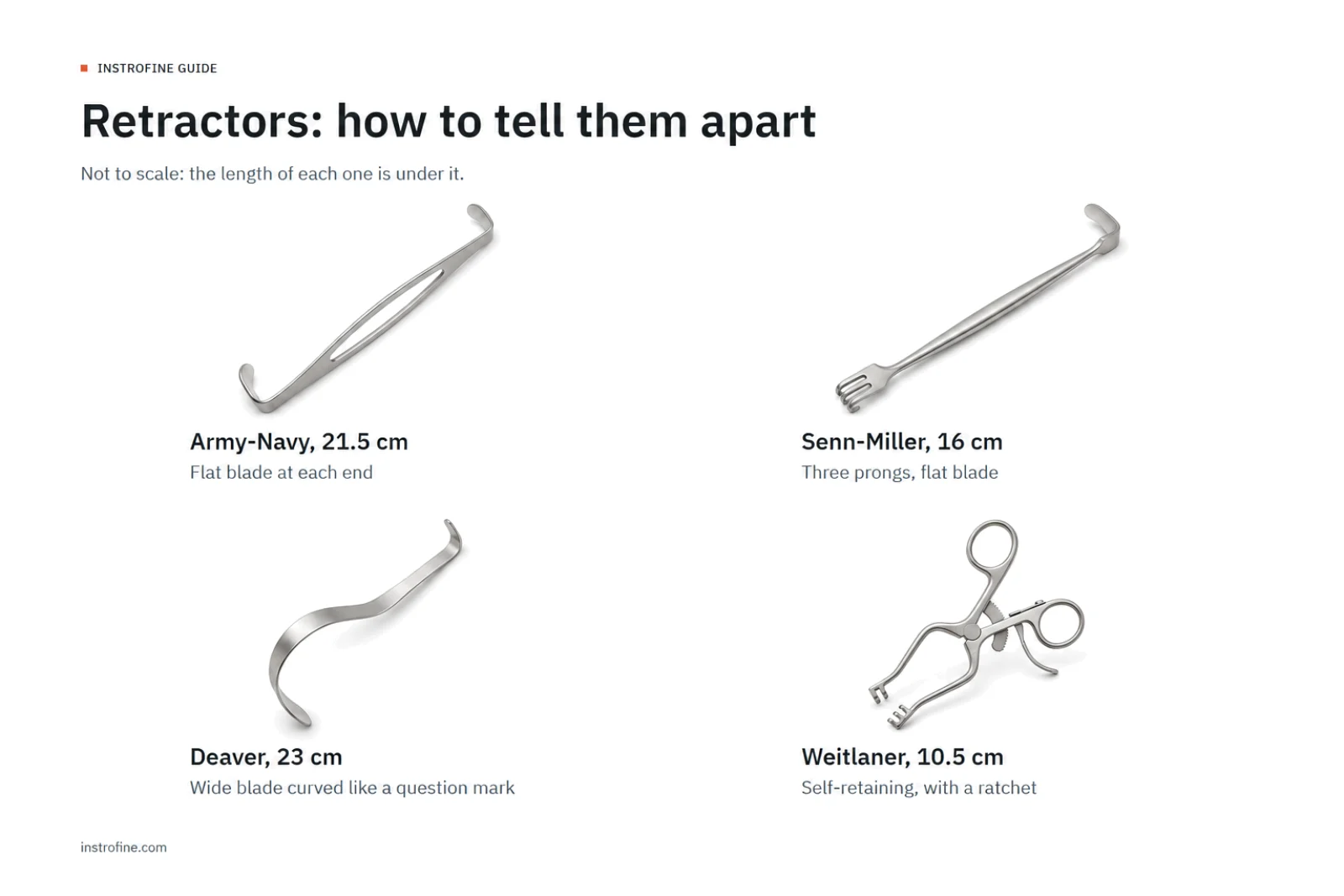
- Army-Navy. Double-ended, with a flat, right-angled blade at each end, for small and medium incisions. Set of 2
- Senn-Miller. Three curved prongs at one end, a flat blade at the other. Sharp or blunt, 16 cm. Senn-Miller Retractor
- Volkmann. A rake with 1, 2, 3, 4 or 6 curved prongs, sharp or blunt, 22 cm. Volkmann Retractor
- Richardson and Kelly. Right-angled blades that hold back the abdominal wall. Kelly has the larger, deeper blade.
- Deaver. A wide, smooth blade curved like a question mark, for deep abdominal and chest surgery. Blade 25–75 mm. Deaver Retractor
- Weitlaner (self-retaining). Pronged arms with a ratchet. Fixed or hinged arms; 2×3 or 3×4 prongs; sharp or blunt. Weitlaner Retractor
- Balfour (self-retaining). An abdominal frame with two side blades and a centre blade. 18, 20 or 25 cm spread, or 9 cm Baby. Balfour Retractor
Suction
- Yankauer. A rigid suction tube with an angled shaft and a rounded tip, for the mouth, throat and operative field. Ours is reusable stainless steel: adult 27 cm, or child 21 cm with a removable tip. Yankauer Suction Tube
Also in a basic set
Kidney dish. A kidney-shaped steel dish that holds instruments, swabs and dressings, or catches fluid close to where you work. Kidney Dish, 17 to 30.5 cm.
These come up in every instrument list but are not yet sold on their own at INSTROFINE:
- Scalpel handle. Handle No. 3 takes blades 10, 11 and 15; handle No. 4 takes the larger blades 20 to 25.
- Allis and Babcock forceps. Both lock with a ratchet. Allis has teeth for firm tissue; Babcock has rounded, smooth jaws for delicate structures such as bowel.
- Towel clamp. Holds drapes in place.
- Sponge-holding forceps. Hold gauze swabs. They are included in several of our OB/GYN sets.
Buying several at once
- Basic Suture Instrument Kit: Mayo-Hegar needle holder, tissue forceps, eye scissors, Littauer stitch scissors and a mosquito forceps. Suture material, needles and practice pads are not included.
- OB/GYN instrument sets: normal delivery, episiotomy, D&C, gynaecological examination and abdominal hysterectomy. Each listing names every piece and size.
- Equipping a clinic, ward or training centre? Send your list for a volume quote.
Every instrument is inspected before it is packed, and unused instruments can be returned within 7 days. Delivery · Returns
Short answers
What are the basic surgical instruments?
A basic general set usually holds scalpel handles, scissors (Mayo and Metzenbaum), thumb forceps, artery forceps, needle holders, retractors, towel clamps and suction. Lists such as “54 basic instruments” differ between hospitals and courses; there is no single standard list.
Is a hemostat the same as artery forceps?
Yes. “Hemostat” is the usual US name and “artery forceps” the usual name in the UK and South Asia. Kelly, Crile, mosquito and Kocher are all patterns of it.
Needle holder or needle driver?
Two names for the same instrument.
What is the difference between tissue forceps and dressing forceps?
Tissue forceps have teeth to hold tissue firmly. Dressing forceps have serrated jaws without teeth, for gauze and dressings.
Metzenbaum or Mayo scissors?
Metzenbaum for delicate tissue, Mayo for tougher tissue such as fascia. For sutures, use straight Mayo or stitch scissors, never Metzenbaum. Full comparison: Metzenbaum vs Mayo scissors.
How do you learn surgical instruments quickly?
Learn the six groups first. Then learn the few details that separate look-alikes: the jaw serrations, the teeth, the length and the handle.
How we checked this guide
Every feature in this guide was checked twice: against the specifications on our own listings, and against catalogues published by instrument makers and distributors. Where the catalogues disagreed, we followed the maker’s specification, and we left out anything we could not confirm.
Spotted something that looks wrong? Email info@instrofine.com and we will check it.
Questions?
Email info@instrofine.com or WhatsApp +92 308 6111128. We reply within 1 business day.
Buying in quantity?
Clinics, hospitals, training centres and distributors can send a request on the Bulk orders page, and we'll reply with a quote.