Guide
Metzenbaum vs Mayo scissors
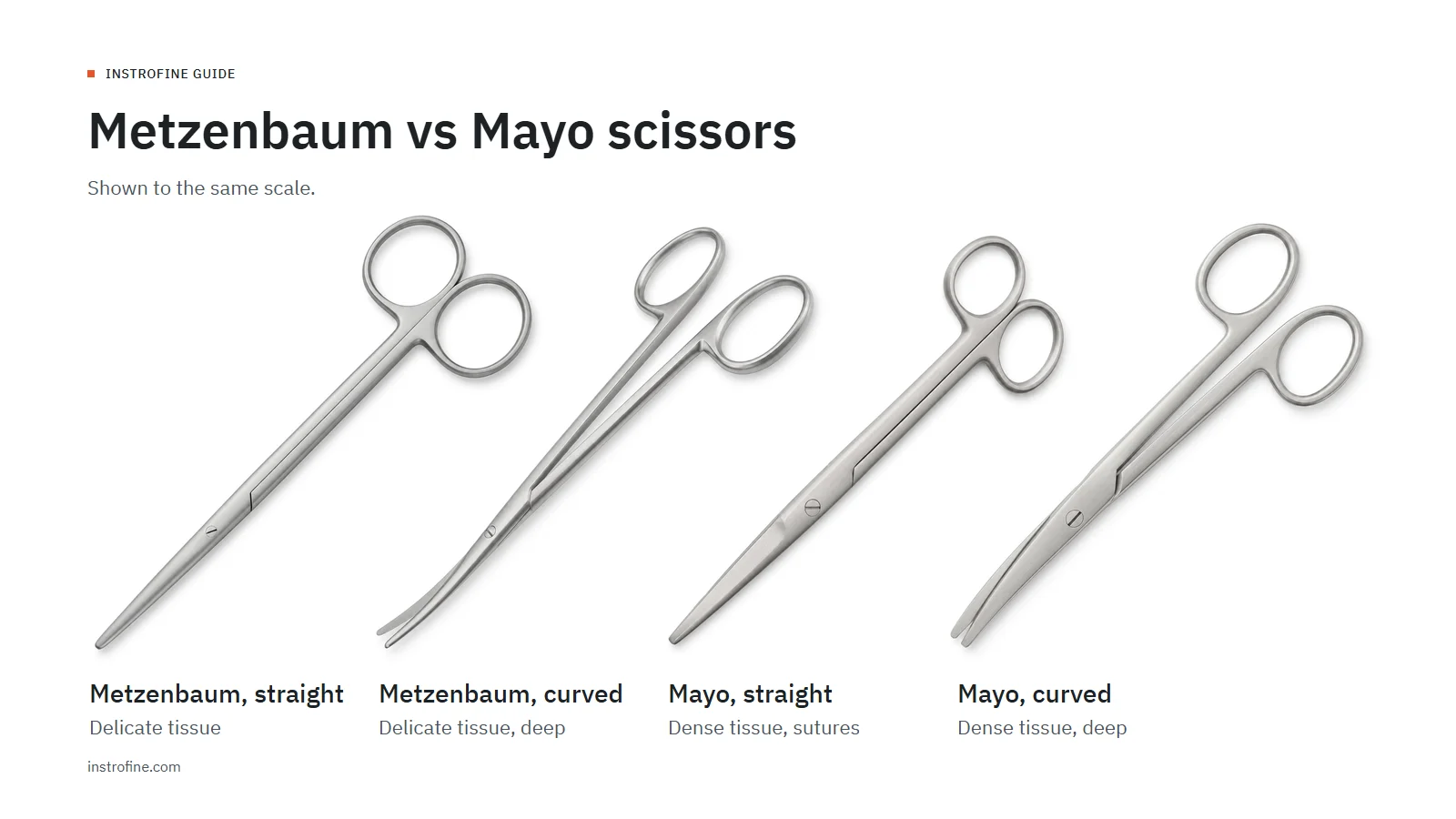
Metzenbaum scissors are light scissors with long shanks and short blades, made for delicate tissue and fine dissection. Mayo scissors are heavier, with blades about a third of their length, made for dense tissue such as fascia; the straight Mayo is also the standard pair for cutting sutures.
Written by the INSTROFINE team. Updated 28 November 2026. How we checked it is explained at the end. This guide helps you choose and identify scissors; it does not teach surgical technique.
In short
- Delicate tissue and fine dissection: Metzenbaum.
- Fascia, muscle and other dense tissue: Mayo.
- Sutures, drapes and dressings: straight Mayo or stitch scissors. Never a Metzenbaum.
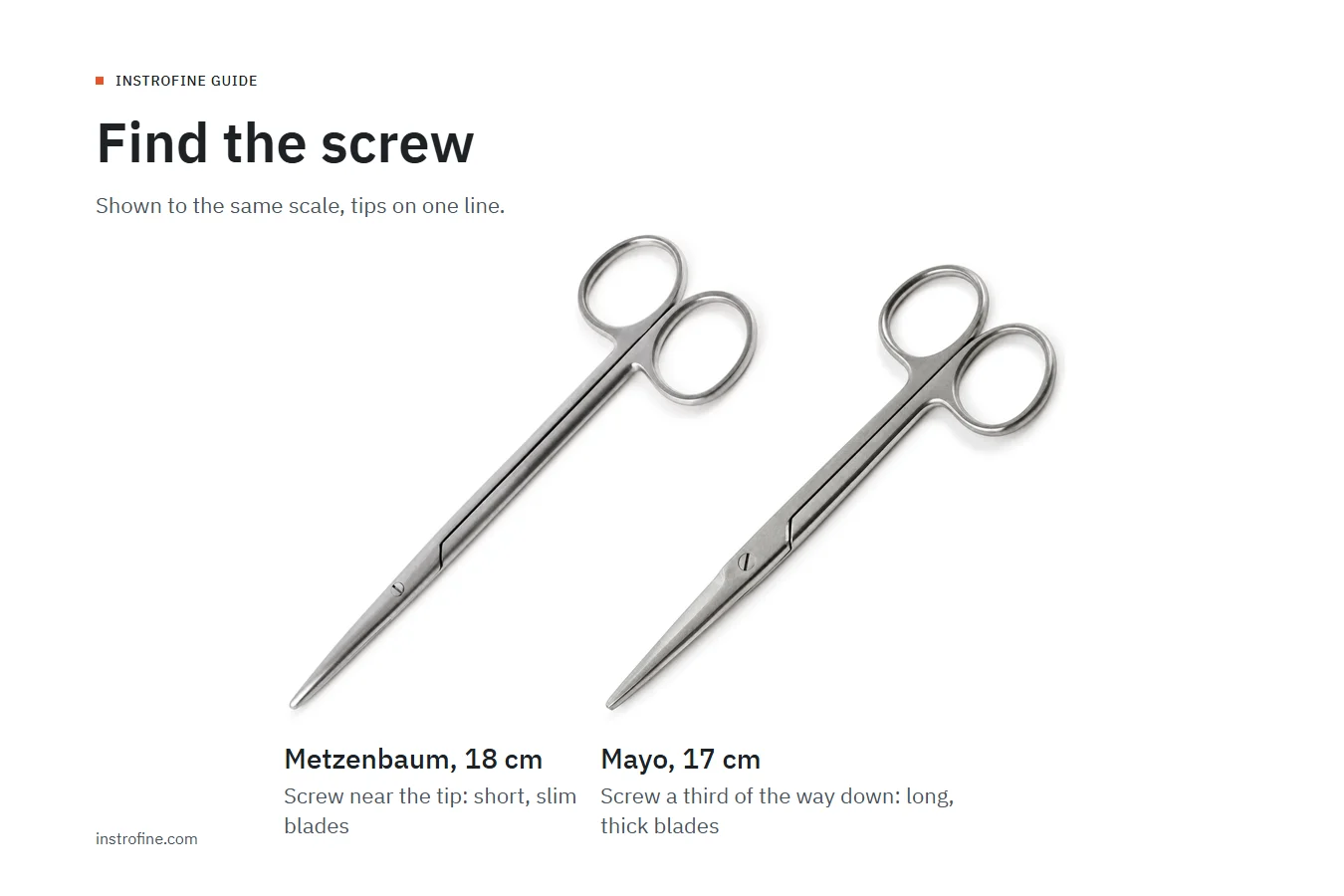
- Can’t tell which pair is which? Look at where the screw sits. The test is below.
Side by side
| Metzenbaum | Mayo | |
|---|---|---|
| Build | Light and slim | Heavier, with thick blades |
| Blades | Short: about 3.5–4 cm on a 15–18 cm pair | About a third of the length: close to 6 cm on a 17 cm pair |
| Screw (pivot) | A fifth to a quarter of the way from the tip | About a third of the way from the tip |
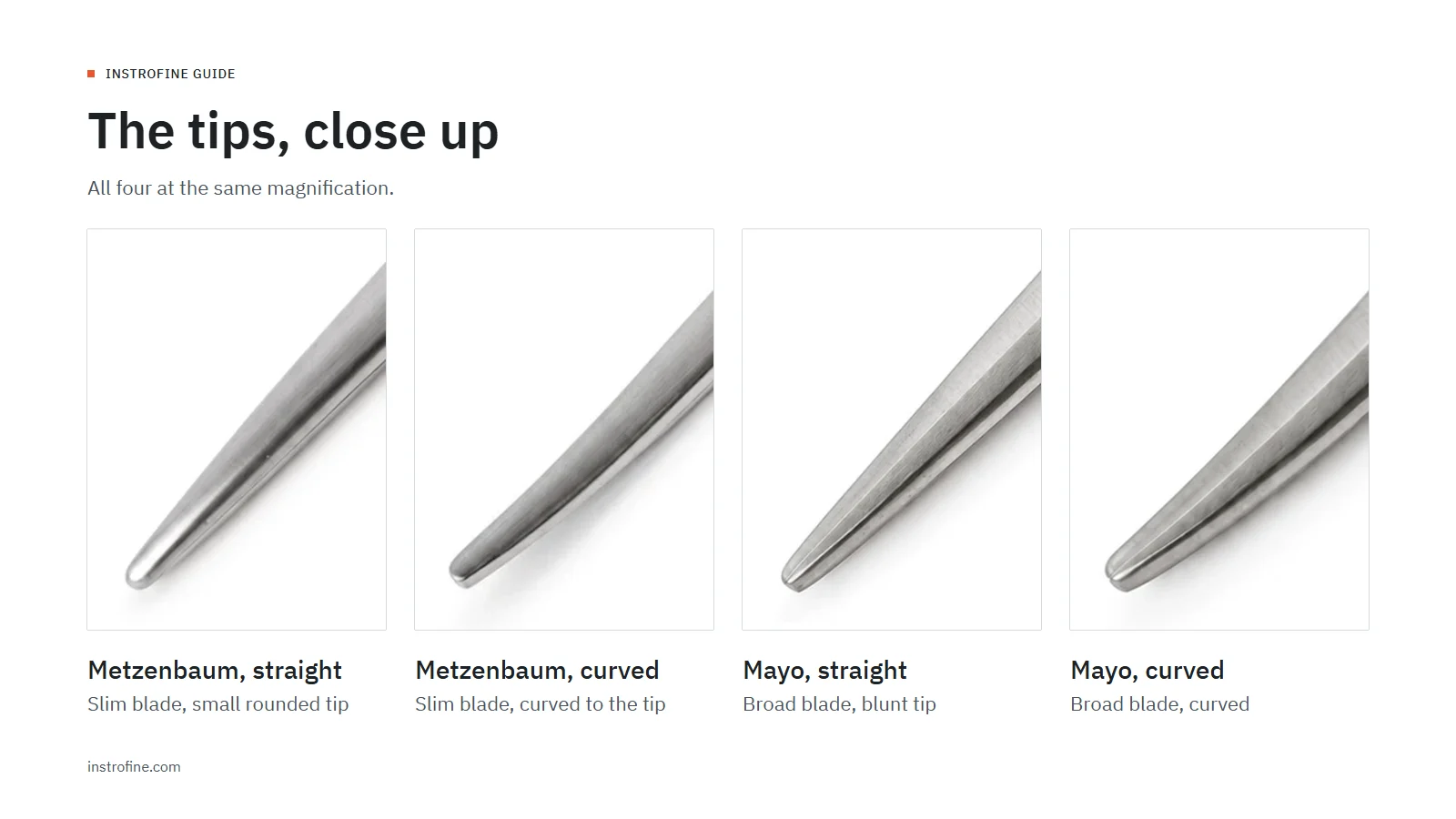
| Tips | Small and rounded, at the end of slim blades | Blunt, at the end of broad blades |
| Main job | Delicate tissue; fine and blunt dissection | Dense tissue such as fascia and muscle |
| Cutting sutures | Never | Straight Mayo: yes |
| Shapes | Straight or curved; curved is more common | Straight or curved |
| Our lengths | 12.5–26 cm | 15–23 cm, and 20–30 cm in the Mayo-Harrington pattern |
| Our prices | From $21 | From $21 |
The blade and screw figures are our measurements on photographs of real instruments, read to within 2 % of the length, and they agree with makers’ listed blade lengths.
Tell them apart in five seconds
Instrument trays often hold both patterns, and the two are easy to mix up. Four checks settle it:
- Find the screw. On a Mayo it sits about a third of the way down from the tip. On a Metzenbaum it is much closer to the tip, with long, slim shanks behind it.
- Look at the blades. Mayo blades are broad and thick; Metzenbaum blades are slim.
- Look at the tips. A Metzenbaum stays slim all the way to a small, rounded tip. A Mayo blade stays broad and narrows only near its blunt tip.
- Still not sure? Keep the pair away from tissue and sutures until someone identifies it. A Mayo used where a Metzenbaum belongs is too coarse for delicate tissue, and a Metzenbaum used on sutures loses its edge.
Gold-coloured rings usually mean tungsten carbide cutting edges; black rings usually mean one razor-sharp blade and one finely serrated blade. Neither changes the pattern: a pair with gold rings can be a Metzenbaum or a Mayo.
When to reach for Metzenbaum
Use Metzenbaum scissors where you need feel more than force: separating tissue layers, trimming thin tissue, and blunt dissection, where you push the closed tips into a tissue plane and open them to spread it. The long shanks multiply the force of your hand, so cut and spread gently; it is easy to put more force on tissue than you meant to.
Choose:
- Metzenbaum Dissecting Scissors, straight or curved, 15, 18, 20, 23 or 26 cm. The everyday pattern. $21–$39.
- Metzenbaum Scissors, delicate, curved, 18 or 23 cm. A finer pattern for finer work. $41–$53.
- Baby Metzenbaum Scissors, 12.5 cm, straight or curved. For small, shallow fields. $29.
When to reach for Mayo
Use Mayo scissors on tissue that would blunt a Metzenbaum: fascia, muscle and, in veterinary surgery, the linea alba. The straight Mayo is the usual suture scissors and also cuts drapes and dressings. The curved Mayo cuts heavy tissue where you need to see the tips.
Choose:
- Mayo Dissecting Scissors, straight or curved, 15, 17 or 23 cm, with beveled blades. $23–$31.
- Mayo Dissecting Scissors, original pattern, straight or curved, 15, 17 or 19 cm, with rounded blades. Same job; choose the blade form your team prefers. $21–$27.
- Baby Mayo Dissecting Scissors, 15 cm. A smaller, lighter Mayo. $21.
- Mayo-Harrington Operating Scissors, 20, 23 or 30 cm. Long and strong, for dense tissue deep in the body. $27–$41.
Every pair is checked before we pack it: how the tips meet, how smoothly the joint moves, and the finish. An unused pair can be returned within 7 days of delivery. Delivery · Returns
Straight or curved?
The pattern decides what the scissors can cut. The curve decides how well you see and reach.
| Open or shallow field | Deep or angled field | |
|---|---|---|
| Dense tissue | Straight Mayo | Curved Mayo |
| Sutures | Straight Mayo | Straight Mayo |
| Delicate tissue | Straight Metzenbaum | Curved Metzenbaum |
A curve lets you see the tips past your own hand and follow a tissue plane. That is why most Metzenbaums in use are curved. For sutures, straight blades are the norm.
Which length?
Choose the shortest pair whose tips reach the tissue while your hand stays outside the wound. Longer scissors are harder to control at the tips.
| Work | Metzenbaum | Mayo |
|---|---|---|
| Small, shallow fields: skin, hand, face, small animals | 12.5–15 cm (5–6 in) | 15 cm (6 in) |
| General open surgery | 18 cm (7 in) | 15–17 cm (6–6.75 in) |
| Deep abdominal or pelvic work | 20–26 cm (8–10.25 in) | 23 cm (9 in), or a Mayo-Harrington |
These are common starting points; surgeons’ preferences vary. A full set shows how they combine: our Abdominal Hysterectomy Instrument Set carries five pairs: a straight Mayo of 17 cm for sutures, curved Mayos of 17 and 23 cm, and curved Metzenbaums of 18 and 23 cm. That gives a shorter pair of each pattern for the surface and a longer one for the pelvis.
Holding and cutting
Put your thumb and ring finger in the rings and rest your index finger on the screw. This keeps the tips steady as you turn your wrist. With the middle or index finger in a ring, the tips swing sideways and you lose control. Cut with the tips, not the middle of the blades.
Keeping the edges sharp
- Give every set a pair for sutures, so no one reaches for the Metzenbaum. Stitch scissors or a straight Mayo do that job.
- Keep Metzenbaums off sutures, wire, drapes and gauze. Each cut on hard material dulls the fine edge.
- Test them. A sharp Mayo or Metzenbaum cuts four layers of gauze cleanly at the tips; scissors shorter than about 10 cm should cut two. If the pair folds or chews the gauze, send it for sharpening instead of cutting harder.
- Clean and sterilise before first use. Our scissors are reusable and supplied non-sterile; follow your facility’s process.
Where the names come from
Metzenbaum scissors were designed by Myron F. Metzenbaum (1876–1944), an ear, nose and throat and reconstructive surgeon in Cleveland, Ohio; early uses included tonsil and perineal operations. Most surgical teams simply call them “Metz”. Mayo scissors are named after the Mayo surgeons of Rochester, Minnesota, where the pattern was developed.
The Mayo name appears on other instruments too. The Mayo-Hegar needle holder holds needles, and the Mayo-Harrington is a longer operating scissors; neither is a Mayo dissecting scissors.
Short answers
Can you cut sutures with Metzenbaum scissors?
No. It dulls the edge you need for dissection. Use a straight Mayo or stitch scissors.
Are Metzenbaum scissors curved or straight?
Both are made. Curved is the more common choice because it lets you see the tips.
Which is heavier, Mayo or Metzenbaum?
Mayo. Its blades are thicker and about a third of its length, against a fifth to a quarter on a Metzenbaum.
What size of Metzenbaum do I need?
18 cm (7 in) is a usual size for general open surgery. Go shorter for small, shallow fields and longer, 20–26 cm, for deep abdominal or pelvic work.
Are Mayo and Metzenbaum scissors used in veterinary surgery?
Yes. The same patterns and the same rule apply: Metzenbaum for delicate tissue, Mayo for dense tissue such as the linea alba.
Ordered the wrong pattern or size?
Tell us within 7 days of delivery. If the pair has not been used or sterilised and is in its original packaging, return it for a refund and order the one you need; you pay the return postage. Unpacking it to look it over is fine. Returns
Can I buy them for a whole department?
Yes. Every size is sold as a single pair, and clinics, hospitals and training centres can request a bulk quote.
How we checked this guide
The uses, grip and care advice were checked against surgical training material and instrument-care standards. The blade and screw figures are our own measurements on photographs of real instruments, compared with makers’ listed blade lengths. Sizes and prices are from our listings on 28 November 2026. We left out claims we could not confirm.
Spotted something that looks wrong? Email info@instrofine.com and we will check it.
Related
Questions?
Email info@instrofine.com or WhatsApp +92 308 6111128. We reply within 1 business day.
Buying in quantity?
Clinics, hospitals, training centres and distributors can send a request on the Bulk orders page, and we'll reply with a quote.