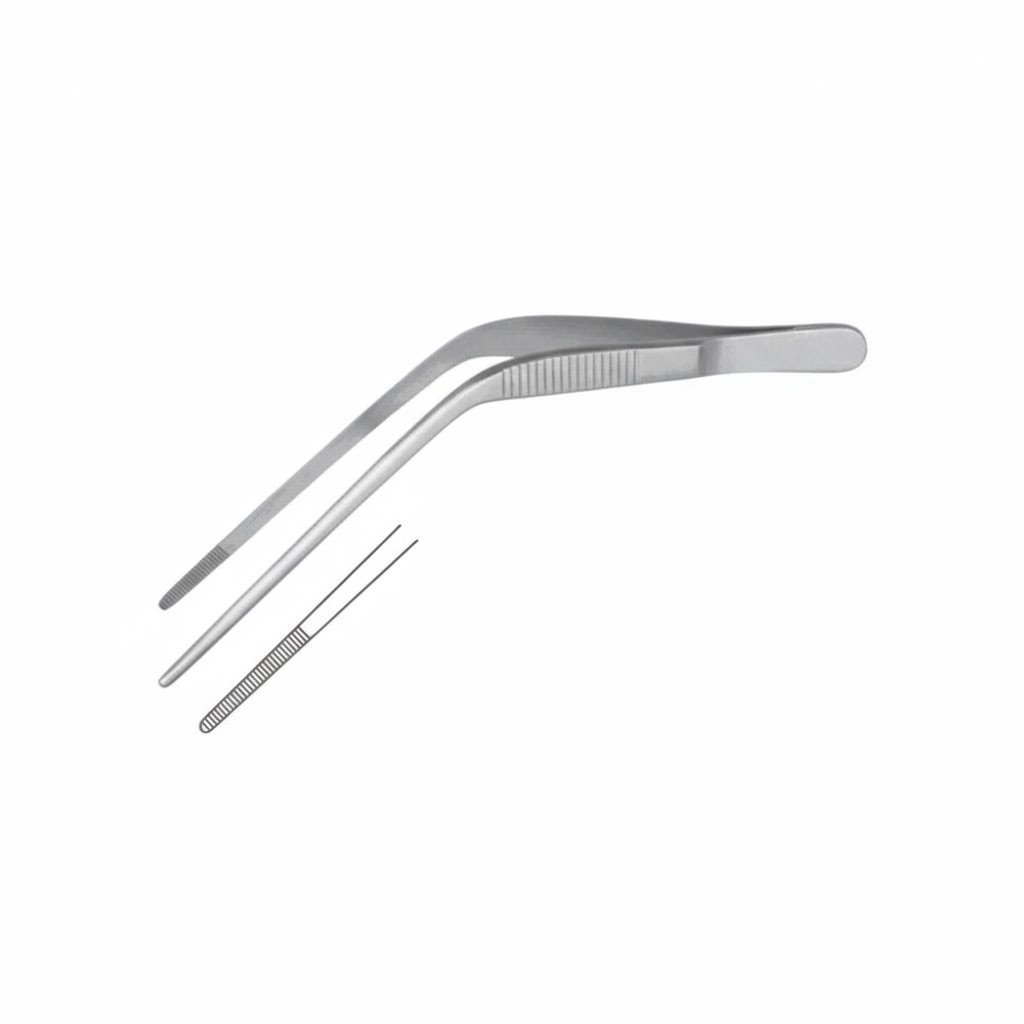
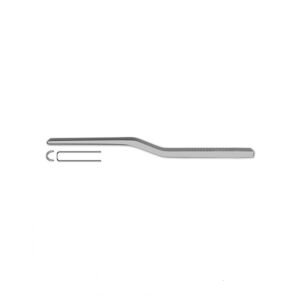
Angling the tips solves a problem specific to working inside the ear and nose. The canal runs at its own angle to the face, and a straight instrument introduced along the surgeon’s line of approach meets the wall rather than the depth. Bending the last section lets the tips follow the canal while the shaft stays outside it — and keeps the surgeon’s hand from blocking the light that has to travel down the same opening.
Serrations rather than teeth follow from what is being handled. Packing, wicks and dressing material are compressible and bulky; serrations grip them by friction across the jaw face, where a tooth would pierce through and let the material slip. Two lengths cover the range: 12.5 cm for the outer canal and nasal vestibule, 16.5 cm where the packing has to be placed deeper.
Specifications
| Pattern | Wilde dressing forceps |
| Lengths | 12.5 cm and 16.5 cm |
| Tips | Angled, serrated |
| Use | Dressings and packing in ENT and general procedures |
| Material | German surgical stainless steel |
| Autoclavable | Yes |
Reviews
There are no reviews yet.