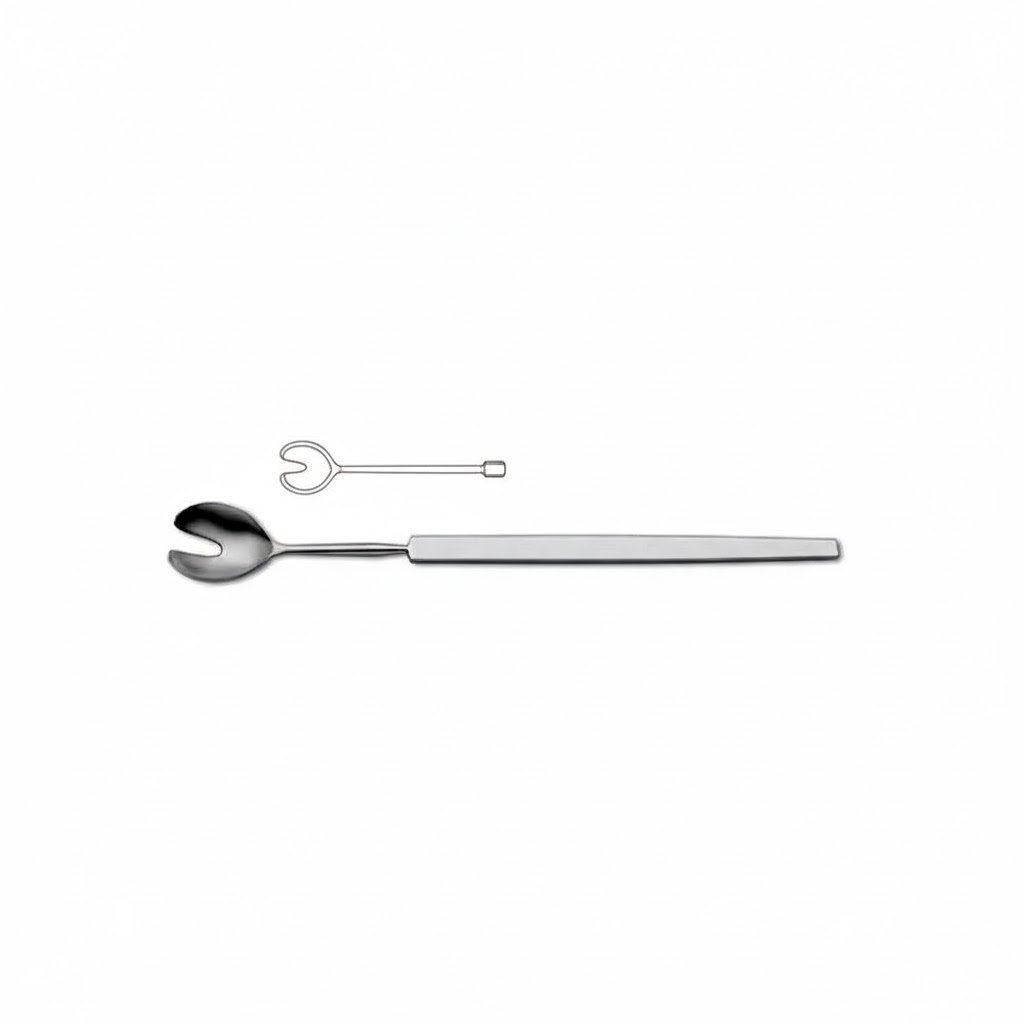
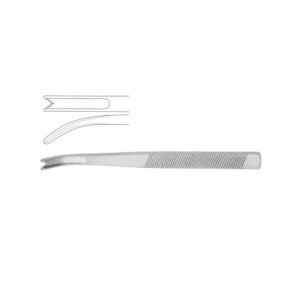
The spoon shape exists because the globe is a sphere in a bony socket, and it has to be lifted without being pressed. A flat instrument passed behind the eye contacts it at an edge and concentrates force on one point of the sclera; a concave spoon cradles the curve, spreading the load across its whole face. The globe then comes forward as a unit rather than being pushed against the orbital wall.
Once it is delivered, the same spoon holds it forward while the surgeon works behind it. The extraocular muscles insert onto the sclera by flat tendons, and each must be identified and divided at the right point — too close to the globe and there is nothing to suture to later, too far and the muscle retracts into the orbit. Holding the globe steady and slightly proud is what makes those insertions visible. At 14 cm the instrument is short, matched to an orbit that is only a few centimetres deep.
Specifications
| Pattern | Wells enucleation spoon |
| Overall length | 14 cm (5½”) |
| Tip | 12.0 mm |
| Use | Enucleation and ocular extraction procedures |
| Speciality | Ophthalmic surgery |
| Material | German stainless steel |
| Autoclavable | Yes |
| SKU | NJM-14655 |
Reviews
There are no reviews yet.