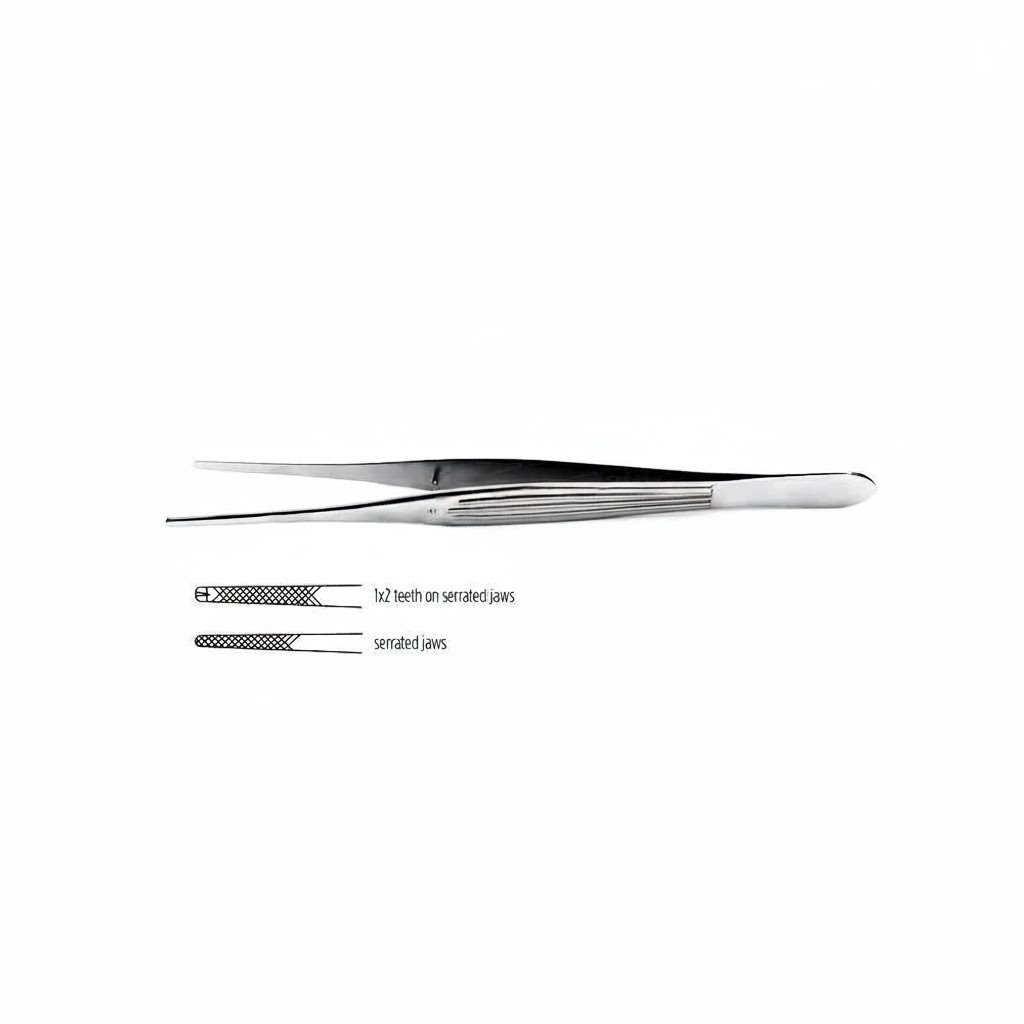
A dissecting forceps is held for longer than a grasping one. Its job is to hold a structure steady while the other hand works around it, which means minutes rather than seconds and constant light pressure between finger and thumb. Serrated handles are what make that sustainable — the grip comes from texture rather than from squeezing, so the fingers are not working to stop the instrument turning.
The jaw options split the work. Plain serrations hold by friction across a face, which suits tissue that must not be pierced and flat material like sutures. Adding 1×2 teeth on the serrated jaw gives an interlocking point at the tip for tissue that will otherwise slide, while keeping the serrated surface behind for everything else — one instrument covering both without an exchange mid-dissection.
Specifications
| Pattern | Waugh dissecting forceps |
| Tips | Fine |
| Jaw options | Serrated, or 1×2 teeth on serrated jaws |
| Handles | Serrated |
| Use | Dissecting and grasping delicate tissue |
| Material | German surgical stainless steel |
| Autoclavable | Yes |
| SKU | NJM-14483 |

Reviews
There are no reviews yet.