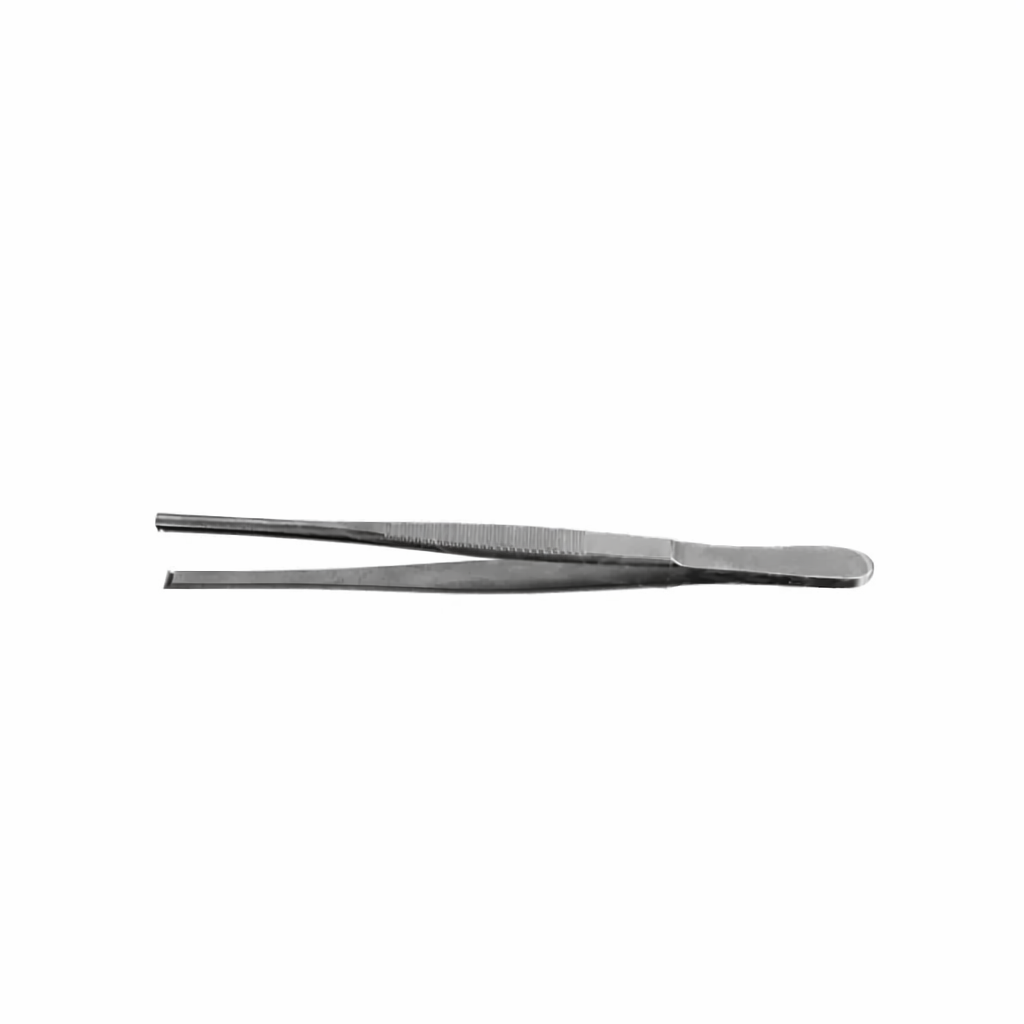
The absence of a lock is the design decision worth understanding. A locking forceps holds the clamp open at a fixed setting — convenient, but it also means the clamp is released by a ratchet letting go, which happens suddenly and at a moment the surgeon does not fully control. On a vessel measured in tenths of a millimetre, a clamp snapping shut is how a vessel wall gets crushed.
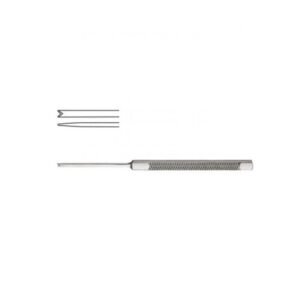
Without a lock the surgeon’s own finger pressure holds the clamp open throughout, so it closes at exactly the rate the fingers release — slow, continuous, stoppable. That is the only way to seat a microvascular clamp accurately. B-1 and B-2 sizes cover 0.4 mm to 1.5 mm, which spans most of the vessels this technique is used on, and the flat handle gives the steady grip that holding a clamp open demands.
Specifications
| Type | Microsurgical clamp applying forceps |
| Overall length | 5½”, straight |
| Clamp compatibility | B-1 and B-2 (0.4 mm – 1.5 mm) |
| Mechanism | Non-locking |
| Handle | Flat |
| Use | Applying microsurgical vessel clamps |
| Material | German stainless steel |
| Autoclavable | Yes |
| SKU | NJM-14443 |
Reviews
There are no reviews yet.