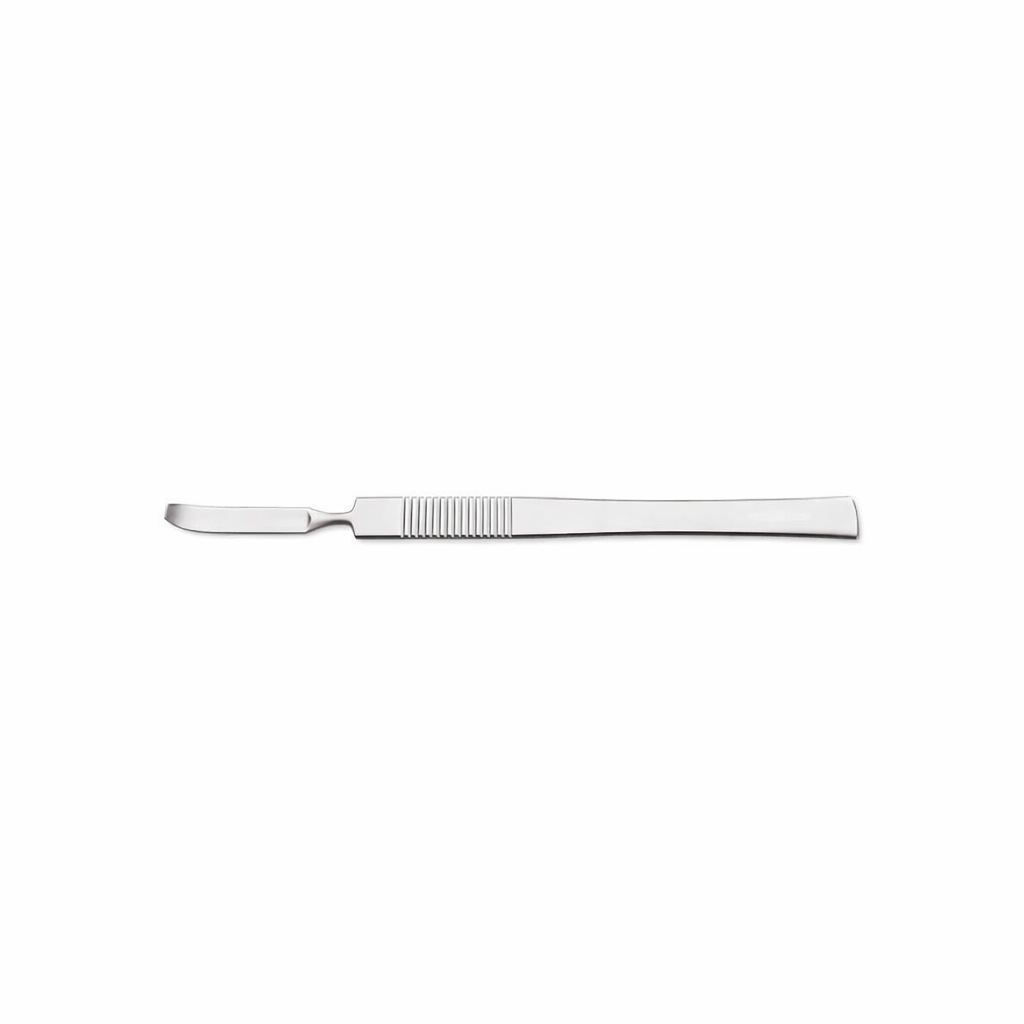
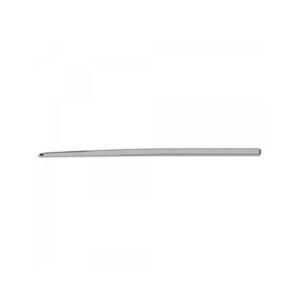
At 14 cm this instrument is deliberately short, and length is what sets its character. A long elevator multiplies every movement of the hand by the time it reaches the tip, which is useful for reaching a distant site but works against precision. A short shaft does the opposite: it is held in the fingers rather than the fist, and the tip moves only as far as the fingertips do. That makes it the instrument for the last few millimetres of a dissection rather than the bulk of it.
The curved tip earns its place by changing the direction of the force. Elevating bone or a firmly held tissue layer means levering, and a curve gives the tip a fulcrum to work against so that a small push at the handle becomes a controlled lift at the working end. The same curve lets the tip approach a surface tangentially for scraping, keeping the working edge in contact instead of digging a corner into the bone.
Specifications
| Pattern | McKenty elevator |
| Overall length | 14.0 cm (5½”) |
| Tip | Curved |
| Use | Tissue dissection, bone elevation and scraping |
| Material | German stainless steel |
| Autoclavable | Yes |
| SKU | NJM-14642 |
Reviews
There are no reviews yet.