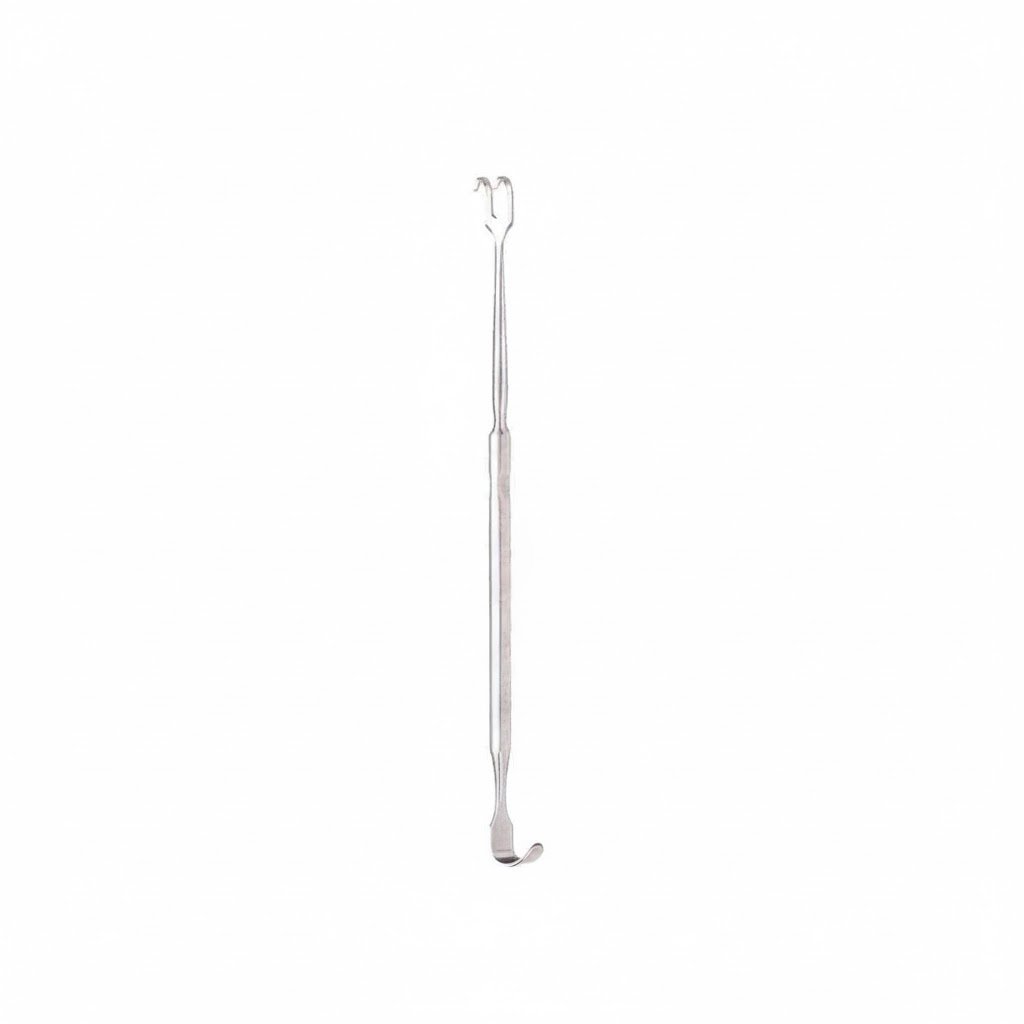
The trachea sits behind several layers that all want to close over it — skin, platysma, strap muscles and the thyroid isthmus — and none of them is fixed in place. Exposing it means holding those layers apart continuously rather than dividing them, so what the retractor does is maintain a corridor through soft tissue that has no natural cavity.
Two working ends earn their place in an approach where the depth changes as the dissection proceeds. Early on the retraction is superficial and wide; by the time the trachea is reached the corridor is narrower and deeper, and the end that suited the first stage is the wrong shape for the second. Reversing the instrument adapts to that without introducing another one into a field where an airway is being opened and speed matters.
Specifications
| Pattern | Jackson tracheal retractor, double-ended |
| Overall length | 17 cm |
| Use | Tracheal exposure in ENT, thoracic and tracheal procedures |
| Material | German stainless steel |
| Reusable | Yes |
| Autoclavable | Yes |
| SKU | NJM-14736 |

Reviews
There are no reviews yet.