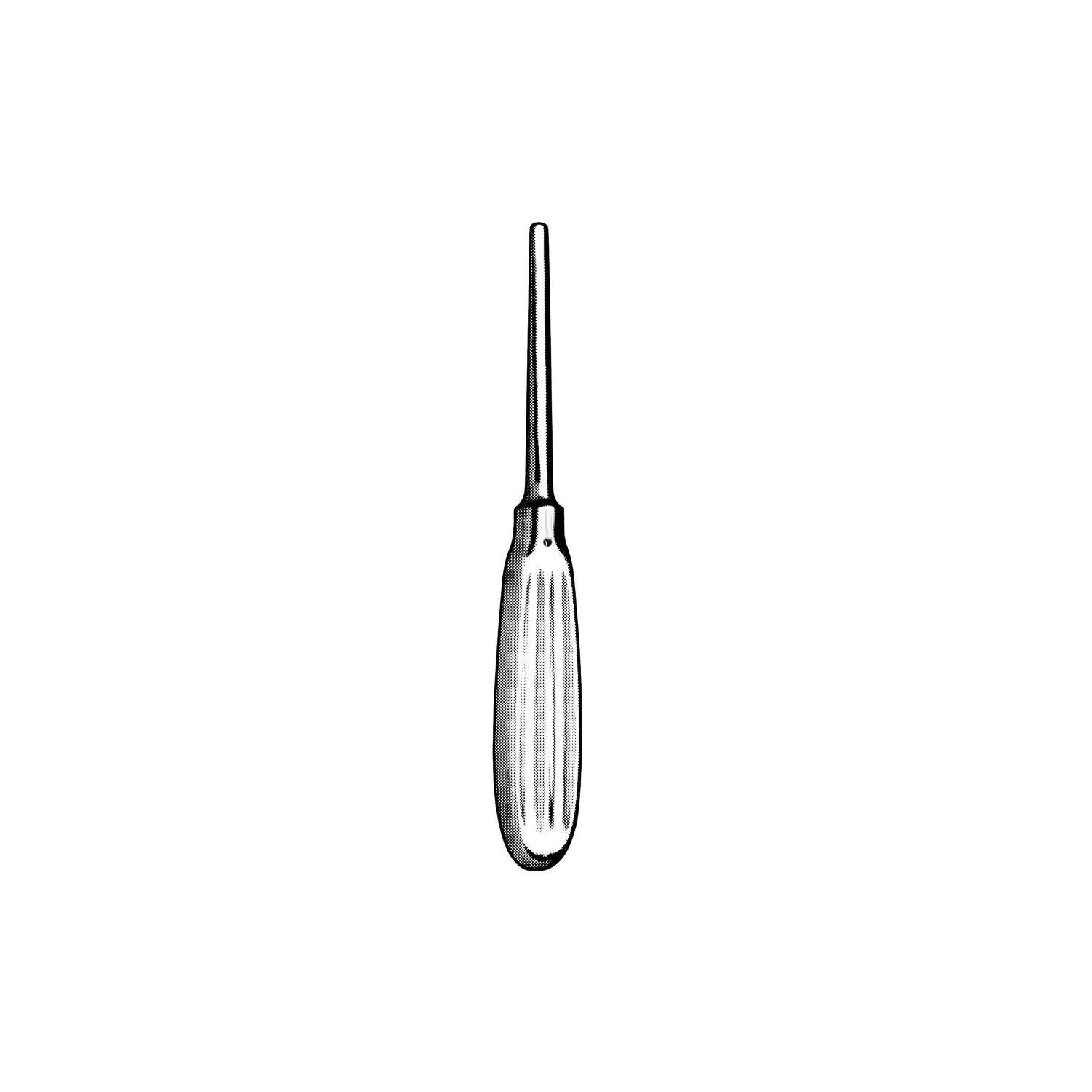
Most septal elevators are built narrow, on the reasoning that a small blade fits the tight spaces inside the nose. The Goldman takes the opposite view for the anterior septum, where there is room: a 6.0 mm blade lifts a broad band of mucoperichondrium in one stroke rather than in several overlapping ones. Fewer passes means fewer junctions between them, and it is at those junctions that a flap gets thinned or torn.
The slight taper keeps that width usable. A blade of constant 6 mm width has to enter the plane at its full size, which is difficult where the tissue is still fully attached; a tapered profile presents a narrower leading edge that widens behind it, so the blade starts small and reaches full width once it is already in the plane. As a displacer it also works in septal fracture procedures, where the broad face bears against the deviated segment and moves it without concentrating force at a point.
Specifications
| Pattern | Goldman displacer septum elevator |
| Overall length | 19.1 cm (7½”) |
| Blade | 6.0 mm wide, slightly tapered |
| Use | Mucoperichondrial flap elevation and septal fracture work |
| Material | German stainless steel |
| Autoclavable | Yes |
| SKU | NJM-14620 |
Reviews
There are no reviews yet.