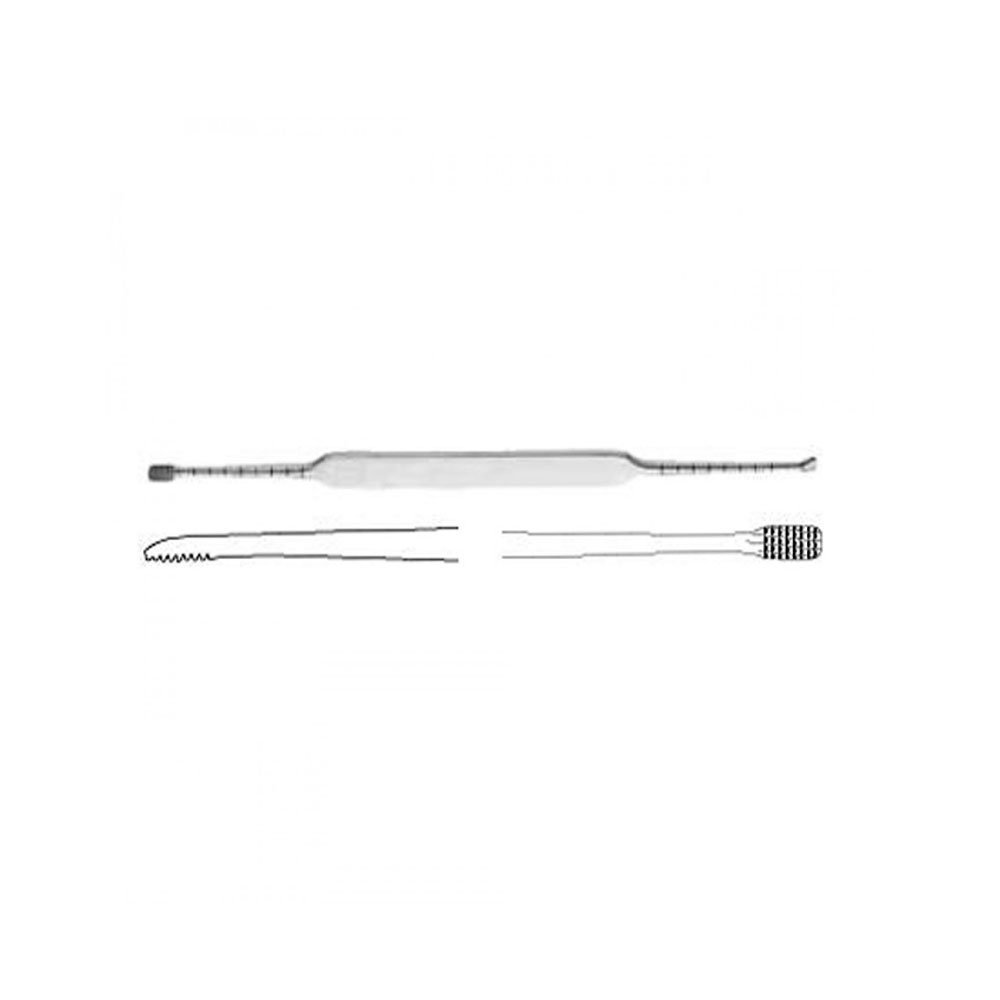
At 21.5 cm this is a long instrument for nasal work, and the length is about sightlines rather than reach. In an open rhinoplasty the dissection runs from a columellar incision up to the radix between the eyes, and the surgeon looks down that same corridor. A short instrument puts the hand directly over the opening; a longer shaft moves the hand back and below, leaving the working tip visible through the narrow gap.
Carrying both a raspatory and an elevator on one shaft reflects how the dissection actually proceeds. The elevator end lifts soft tissue off the cartilaginous and bony framework; the raspatory end works against bone itself, smoothing and clearing where the periosteum has been raised. These alternate continuously as the dissection moves up the dorsum, and reversing one instrument is faster and less disruptive than exchanging two in a field where the flap is being held open.
Specifications
| Pattern | Daniel Gubisch raspatory / elevator, double-ended |
| Overall length | 21.5 cm |
| Use | Nasal reconstructive and rhinoplasty dissection |
| Material | German stainless steel |
| Autoclavable | Yes |
| SKU | NJM-14124 |

Reviews
There are no reviews yet.