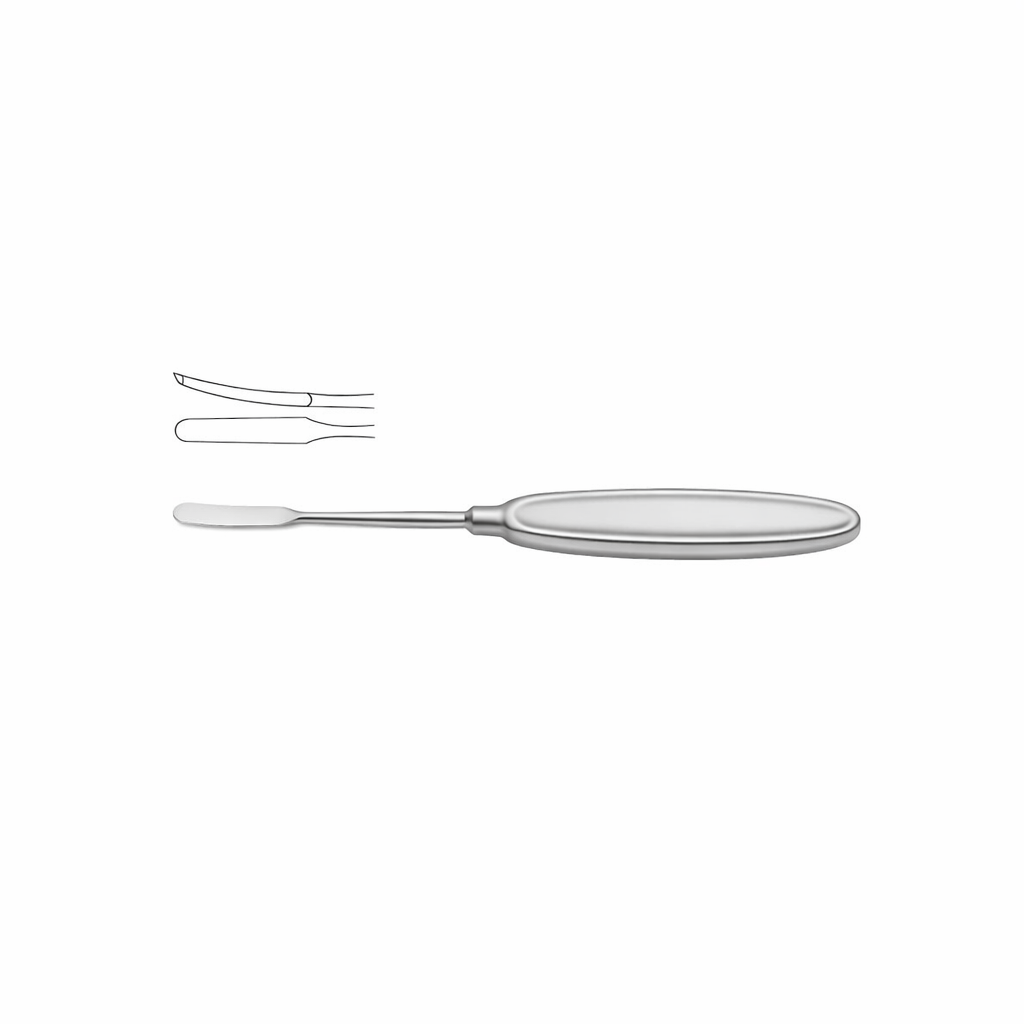
Getting started is the hard part of periosteal elevation, and the curved tip addresses it. A straight blade approaching bone at a shallow angle either skids across the surface or digs into it; to get under the layer the surgeon has to lift the tissue first and then insert, which risks tearing the very membrane being raised. A curved tip meets the bone tangentially and slides beneath the layer on its own, opening the plane before any lifting force is applied.
Once the plane is open the wide-set handle takes over. Scraping bone and elevating a firmly attached layer needs force delivered from the palm and forearm, not the fingertips, and a broad handle spreads that load across the whole hand instead of pinching it into a two-finger grip. At 17.8 cm with a 4.0 mm blade the instrument stays sized for facial bones, where the surfaces are small and curved and a larger elevator would be working blind.
Specifications
| Pattern | Converse periosteal elevator |
| Overall length | 17.8 cm (7″) |
| Blade width | 4.0 mm |
| Tip | Curved |
| Handle | Wide-set, for leverage |
| Use | Periosteal elevation and bone scraping |
| Material | German stainless steel |
| Autoclavable | Yes |
| SKU | NJM-14600 |

Reviews
There are no reviews yet.