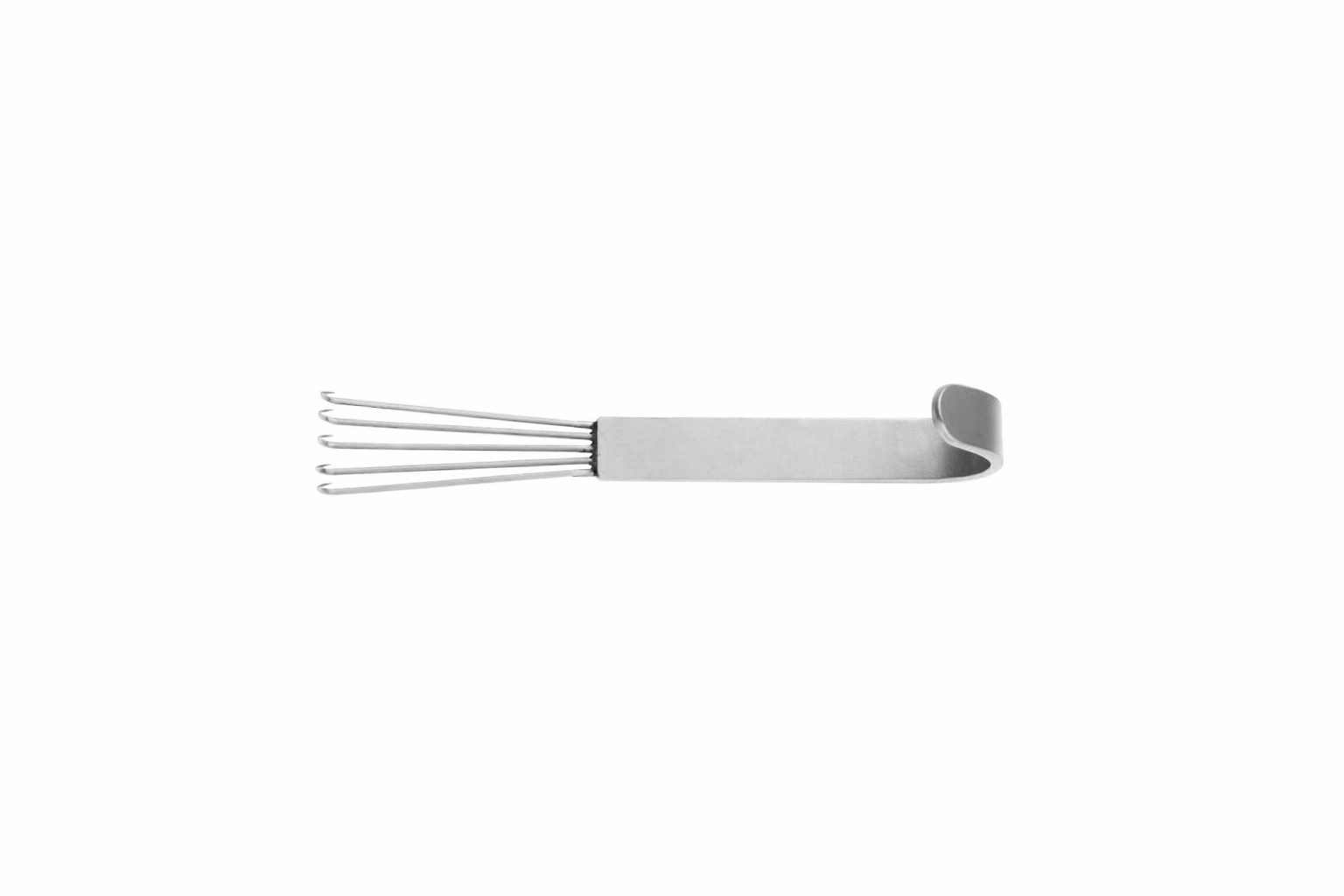
A bear claw is a set of curved prongs arranged to close inward, and the shape is what gives it its hold. A blade retractor keeps tissue back by pressure, so it slips the moment the angle changes; curved prongs hook into the tissue and the curve means that pulling harder seats them more firmly rather than dragging them out. That is the property worth having when the retraction has to survive an assistant shifting their grip.
The trade is that a claw engages rather than rests, so it is chosen for tissue robust enough to take it — fascia, a heavy skin edge, muscle — not for delicate flaps where a blade or a fine rake is the right instrument. At 12 cm this is a short retractor, held in the fingers for superficial and moderate-depth exposures rather than reaching into a cavity.
Specifications
| Pattern | Anderson bear claw retractor |
| Overall length | 12 cm |
| Form | Curved claw prongs |
| Use | Tissue retraction and exposure in general surgery |
| Material | German surgical stainless steel |
| Reusable | Yes |
| Autoclavable | Yes |
| SKU | NJM-14661 |
Reviews
There are no reviews yet.