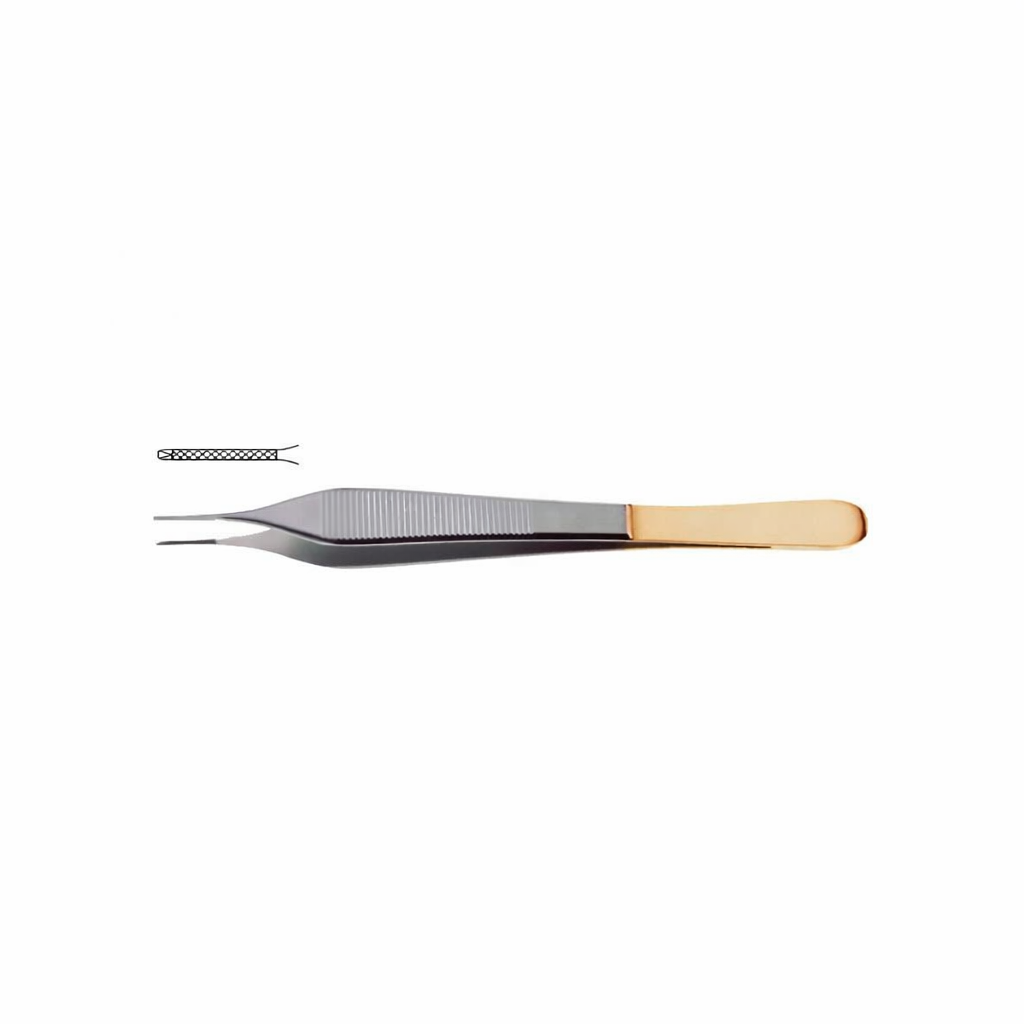
Pyramid serrations grip differently from the parallel ridges on an ordinary jaw. A ridge resists movement across it but lets material slide along it; a pyramid presents faces in every direction, so a needle or suture is held whichever way it tries to move. That is why the pattern is milled rather than cut — pyramids only work if the two jaws meet in exact register, point against valley.
Pairing them with very fine 1×2 teeth covers the two halves of delicate suturing. The teeth interlock through tissue to hold a wound edge steady; the pyramids behind hold the needle that passes through it. Two lengths, 12 cm and 15 cm, set how far the tips reach — the shorter for surface work held in the fingers, the longer where the hand must stay back from the field.
Specifications
| Pattern | Horton-Adson forceps |
| Lengths | 12 cm and 15 cm |
| Teeth | Very fine 1×2 |
| Serrations | Precision-milled tungsten carbide pyramids |
| Use | Delicate suturing, needle placement and tissue handling |
| Material | German stainless steel with tungsten carbide |
| Autoclavable | Yes |


Reviews
There are no reviews yet.