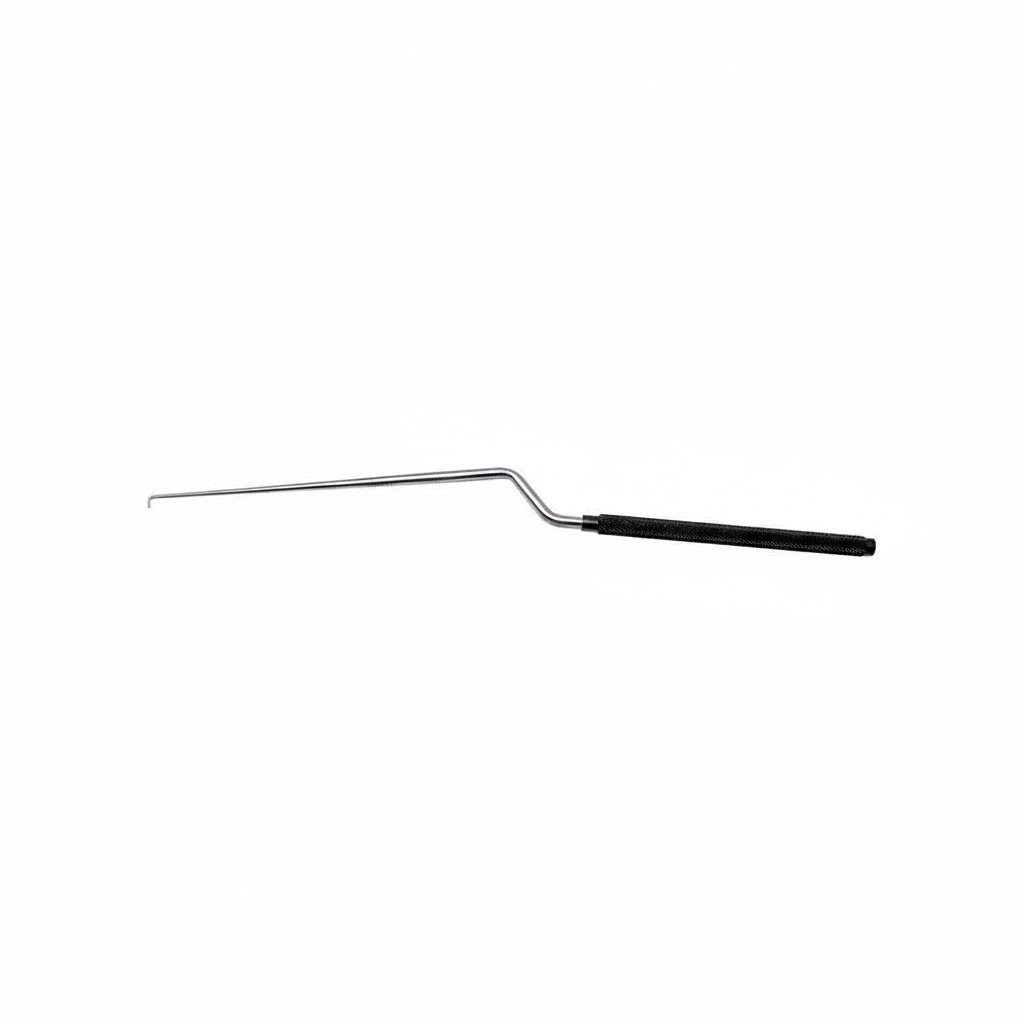
A bayonet shank steps the shaft sideways and then forward again, so the working tip and the handle sit on parallel but offset axes. In spinal and microsurgical work that offset is what makes the tip visible: the approach is a narrow channel viewed from directly above, and a straight instrument puts the surgeon’s fingers squarely between the eye and the tip. Under a microscope, where depth of field is measured in millimetres, an obstructed view is the same as no view.
The hook itself is used to lift and displace nerve tissue rather than grip it — a blunt curve passed beneath a root retracts it a few millimetres so the surgeon can see or work behind it. That is a task with very little margin, which is why the knurled handle matters: the grip has to be positive with wet gloves, because a hand that slips while a hook sits under a nerve root is not a recoverable error. 150 mm of working length reaches the floor of a deep exposure with the handle still clear of the wound.
Specifications
| Type | Bayonet nerve hook |
| Working length | 150 mm (6″) |
| Shank | Bayonet offset |
| Handle | Knurled |
| Use | Spinal surgery, microsurgery, nerve manipulation |
| Material | German stainless steel |
| Autoclavable | Yes |
| SKU | NJM-14672 |
Reviews
There are no reviews yet.