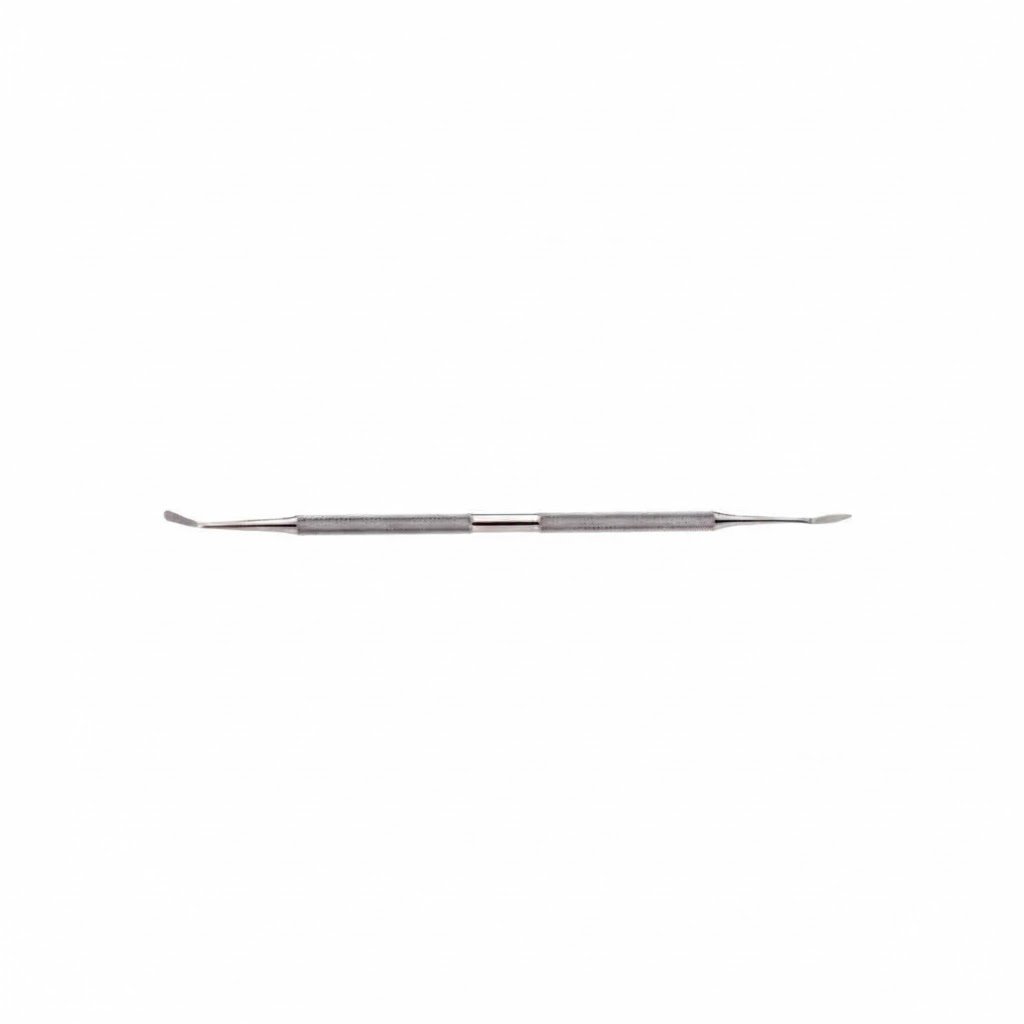
The two ends divide the work of starting a plane and continuing it. The 2 × 11 mm semi-sharp tip is narrow and long enough to find the edge of the periosteum and separate the first few millimetres, which is the hardest part of any elevation because the layer is still fully attached. Once the plane is open the 4 × 10 mm flat edge takes over, spreading the load across a wider front so the layer lifts evenly instead of tearing where a narrow tip concentrates force.
Its slimness is what lets it work behind curvatures and bony spurs. Tissue on the far side of a ridge is invisible and reachable only by an instrument thin enough to slip past the ridge and flexible in approach angle — the reason this pattern persists in maxillofacial and reconstructive sets where the anatomy is rarely a flat surface. At 18 cm it is short enough to be controlled from the fingers, matching the millimetre-scale movements the tips are shaped for.
Specifications
| Pattern | Woodson double-ended elevator |
| Overall length | 18 cm (7″) |
| End 1 | 4 mm × 10 mm flat edge |
| End 2 | 2 mm × 11 mm semi-sharp tip |
| Use | Periosteal elevation and soft tissue dissection |
| Material | German stainless steel |
| Autoclavable | Yes |
| SKU | NJM-14658 |

Reviews
There are no reviews yet.