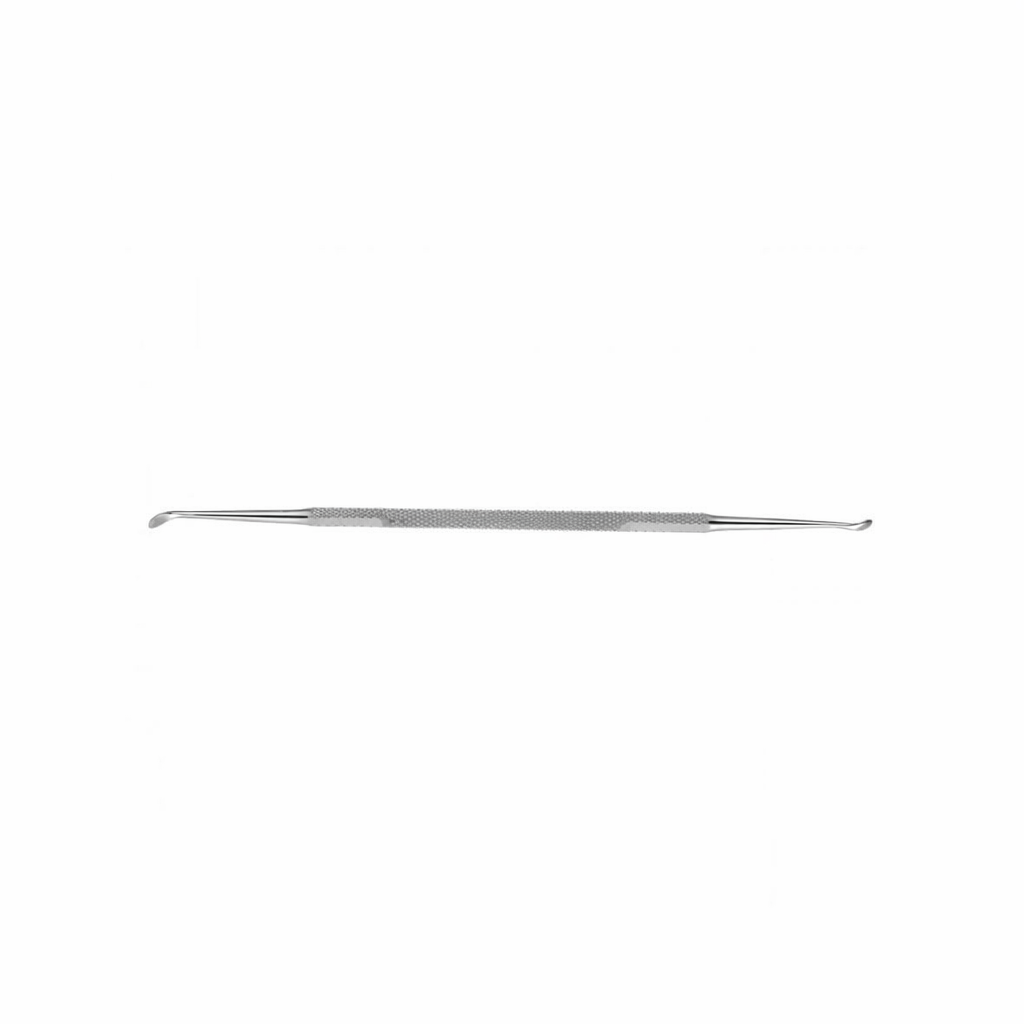
A spoon tip behaves differently from a flat blade in one important way: it makes contact around its rim rather than across its whole surface. That rim finds and holds the edge of a tissue layer, so the layer is lifted from its margin instead of being pushed at from underneath. On a curved surface — a bone contour, the wall of a socket — a flat blade rocks on its corners while a concave one seats against the curve and stays put.
The hollow also carries what is lifted. Small fragments of tissue or bone gathered during elevation sit in the concavity rather than sliding off the blade, which matters when the same movement is meant to both raise and clear. The two tip sizes, 3.7 mm and 4.6 mm, differ by under a millimetre so the surgeon can match the cup closely to the width of what is being lifted, and 171 mm keeps the whole instrument within finger control.
Specifications
| Type | Spoon-shaped elevator, double-ended |
| Overall length | 171 mm (6¾”) |
| Tips | Spoon-shaped, 3.7 mm and 4.6 mm |
| Material | J2 German stainless steel |
| Autoclavable | Yes |
| SKU | NJM-14648 |

Reviews
There are no reviews yet.