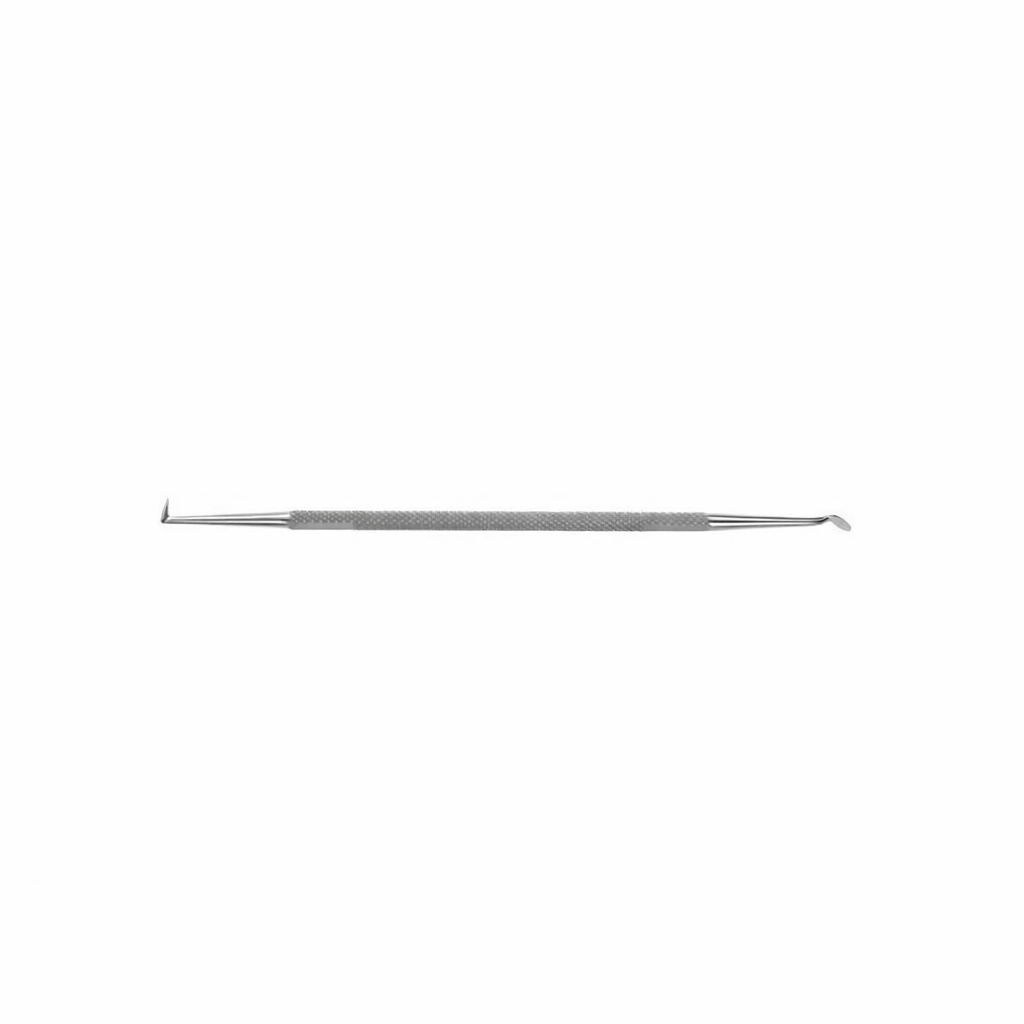
Trimming and elevating are opposite actions, and this instrument carries one of each. The knife end cuts mucosa to a clean margin — necessary when a flap edge is ragged or redundant and will not lie back down against bone without trimming. The spoon end does the reverse: its concave, blunt profile slides under tissue and lifts it away without cutting, following the curve of an alveolar ridge or socket wall.
Pairing them matters in oral surgery because the two tasks alternate within a small field, often within the same socket. Raising a flap, trimming its edge, then elevating further would otherwise mean passing instruments back and forth across a patient’s face several times in a procedure that may last only minutes. At 17 cm the instrument is sized for intraoral work, short enough that the handle does not foul the opposite arch when the tip is working at the back of the mouth.
Specifications
| Pattern | Mitchells trimmer elevator |
| Overall length | 17 cm (6⅝”) |
| End 1 | Knife blade, for mucosal trimming |
| End 2 | Spoon-shaped elevator |
| Use | Dental and oral surgical procedures |
| Material | German stainless steel |
| Autoclavable | Yes |
| SKU | NJM-14643 |

Reviews
There are no reviews yet.