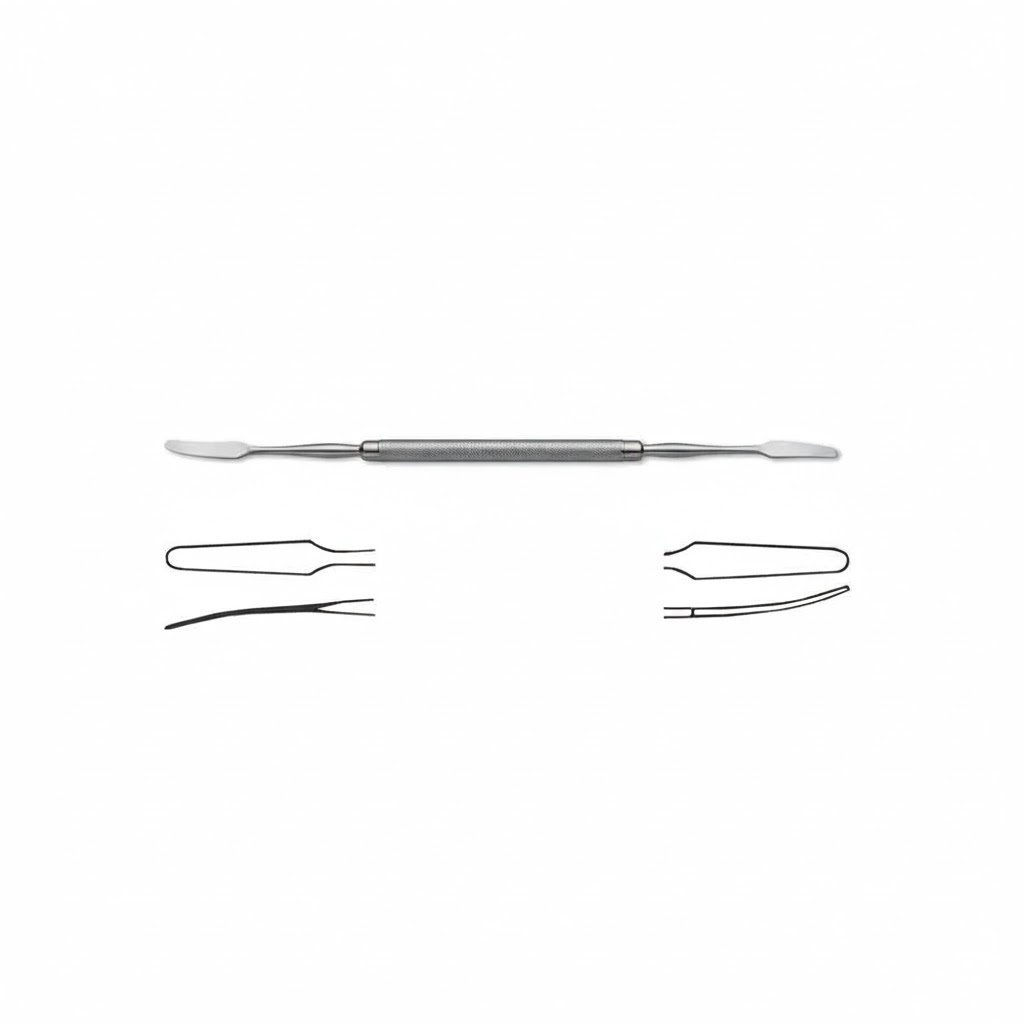
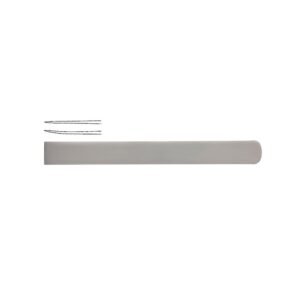
The two ends are almost the same width but taper at noticeably different rates — one narrowing by 0.6 mm, the other by 1.3 mm over the same blade. That difference is the point. A tapered blade presents a narrow leading edge that widens behind it, so the amount of tissue being lifted grows as the blade advances; how fast it grows determines how the blade behaves against a contour. The gentler taper follows a gradual curve; the sharper one turns a tighter corner without the shoulder of the blade catching.
Septal anatomy is exactly where that matters, because the surface is not uniformly flat. Deviations, spurs and the crest where cartilage meets the maxilla all change the contour the elevator has to trace, and a blade whose taper does not match will either lift off the surface or dig into it. Carrying both rates on one 18.5 cm shaft lets the surgeon change the geometry of the blade to suit the region without leaving the nostril.
Specifications
| Pattern | Killian septum elevator, double-ended |
| Overall length | 18.5 cm (7¼”) |
| End 1 | 4.0 mm wide, 3.4 mm taper |
| End 2 | 4.3 mm wide, 3.0 mm taper |
| Use | Septoplasty and reconstructive nasal surgery |
| Material | German stainless steel |
| Autoclavable | Yes |
| SKU | NJM-14631 |
Reviews
There are no reviews yet.