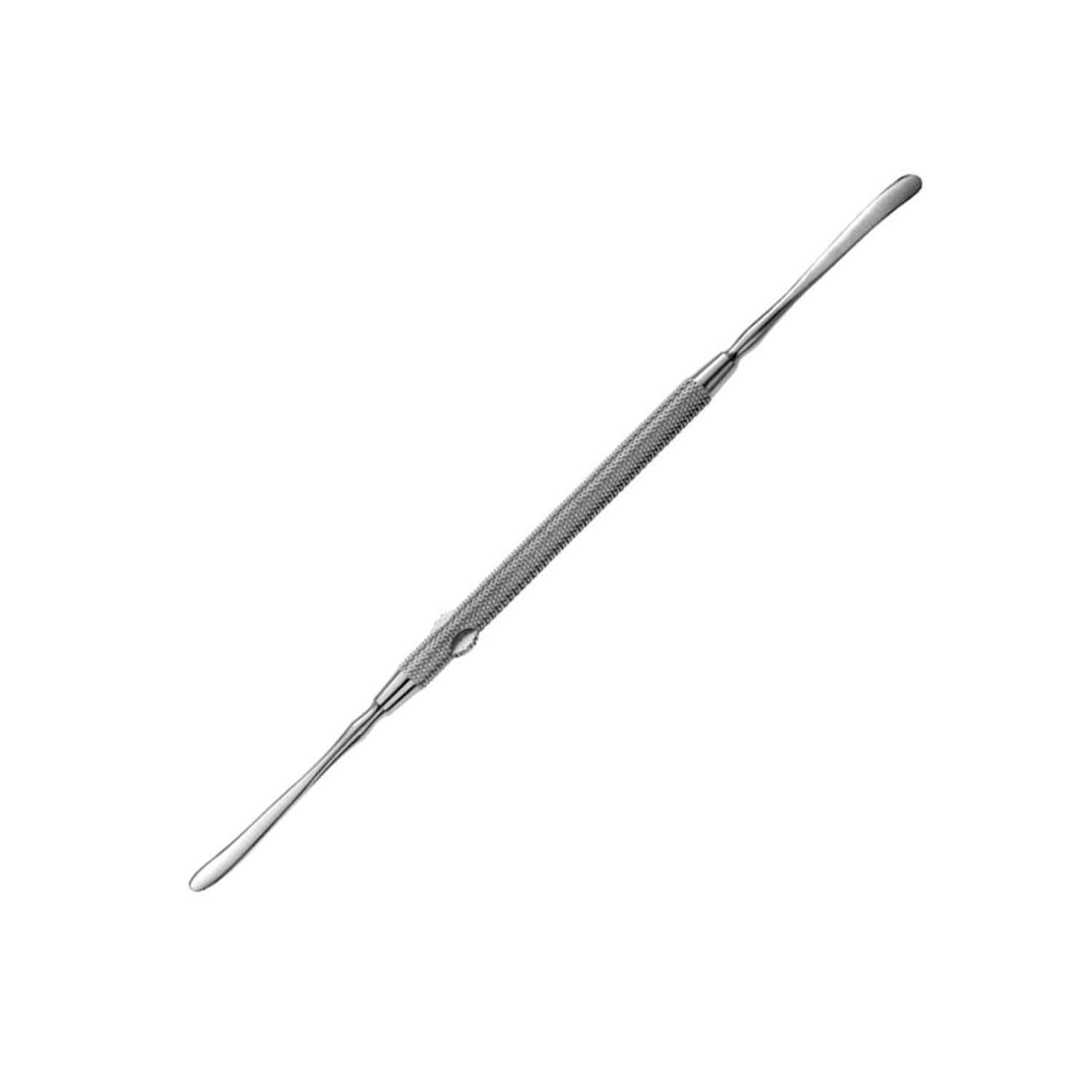
The Freer is the elevator most nasal sets are built around, and the sharp/blunt pairing is why. Perichondrium is bonded to cartilage tightly enough that the plane will not open under blunt pressure alone — the sharp end is needed to cut into the interface and establish it. Once open, the blunt end continues, sliding along the plane and separating tissue without dividing anything. Using the sharp end for that continuation is what perforates a septum.
The round handle lets the blade be rolled to stay flat against a surface that curves in every direction inside the nose, without releasing the grip to re-position. Two blade widths cover the range of the anatomy: 6.0 mm lifts a broad front over the bony dorsum and septal body, while 4.5 mm works where the space narrows and a wider blade would have to be forced.
Specifications
| Pattern | Freer periosteal elevator, double-ended |
| Overall length | 19 cm |
| Ends | One sharp, one blunt |
| Blade widths | 6.0 mm and 4.5 mm |
| Handle | Round |
| Use | Nasal periosteum and perichondrium elevation |
| Material | German stainless steel |
| Autoclavable | Yes |
| SKU | NJM-14616 |

Reviews
There are no reviews yet.